FiiO K13 R2R Review
FiiO K13 R2R Review
Introduction:
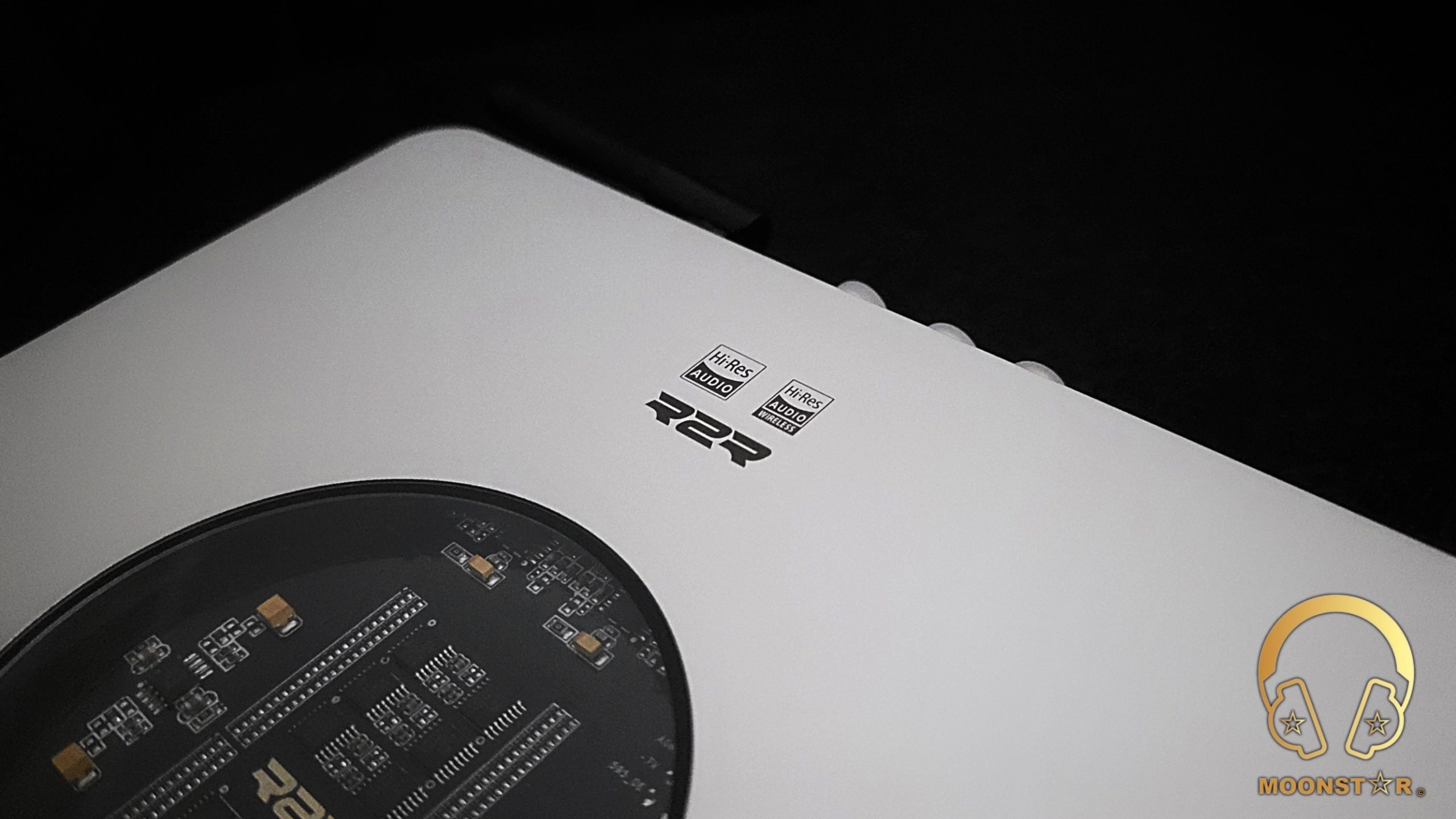
The FiiO K13 R2R Desktop DAC and Headphone Amplifier is an impressive mid-range audio solution, confidently priced around the $300 mark. Positioned above entry level, the K13 R2R distinguishes itself by leveraging a sophisticated R2R architecture. This Resistor to Resistor Ladder design is celebrated for its natural and smooth sonic signature, challenging traditional Delta Sigma converters in this segment. The unit is officially Hi Res Audio and Hi Res Audio Wireless certified.
The K13 R2R integrates FiiO’s proprietary 24 bit R2R resistor array with a high current discrete amplification stage. This potent combination yields a substantial 2400mW output per channel into a 32 ohm balanced load. This provides exceptional control to effectively drive high impedance and challenging planar magnetic headphones. The unit offers switchable operational modes NOS/OS for sonic customization. Coupled with comprehensive I/O, which includes balanced XLR, dual USB C ports, and high resolution Bluetooth 5.4 LDAC, it functions as an effective, high performance desktop hub focused on musical engagement and technical proficiency.
Now, let’s take a closer look at the key features and performance that make the FiiO K13 R2R such a compelling proposition.
Disclaimer:
I would like to thank FiiO for providing me the K13 R2R Desktop DAC & Headphone Amplifier as a review sample. I am not affiliated with FiiO beyond this review, and these words reflect my true and unaltered opinions about the product. As always, audio impressions are subjective, and my findings are based purely on my direct experience with the unit.
Price & Availability:
The actual price for the FiiO K13 R2R Desktop DAC & Headphone Amplifier is approximately $320 USD, a price point that makes the integration of R2R technology and 2400 mW of power remarkably accessible. More information can be found under the link below;
Package & Accessories:
The FiiO K13 R2R is shipped in a standard, rectangular cardboard box. The box exterior includes the product name (“FiiO K13 R2R”), an illustration of the device, and labeling that dientifies the unit as a “Desktop DAC and Headphone Amplifier”.
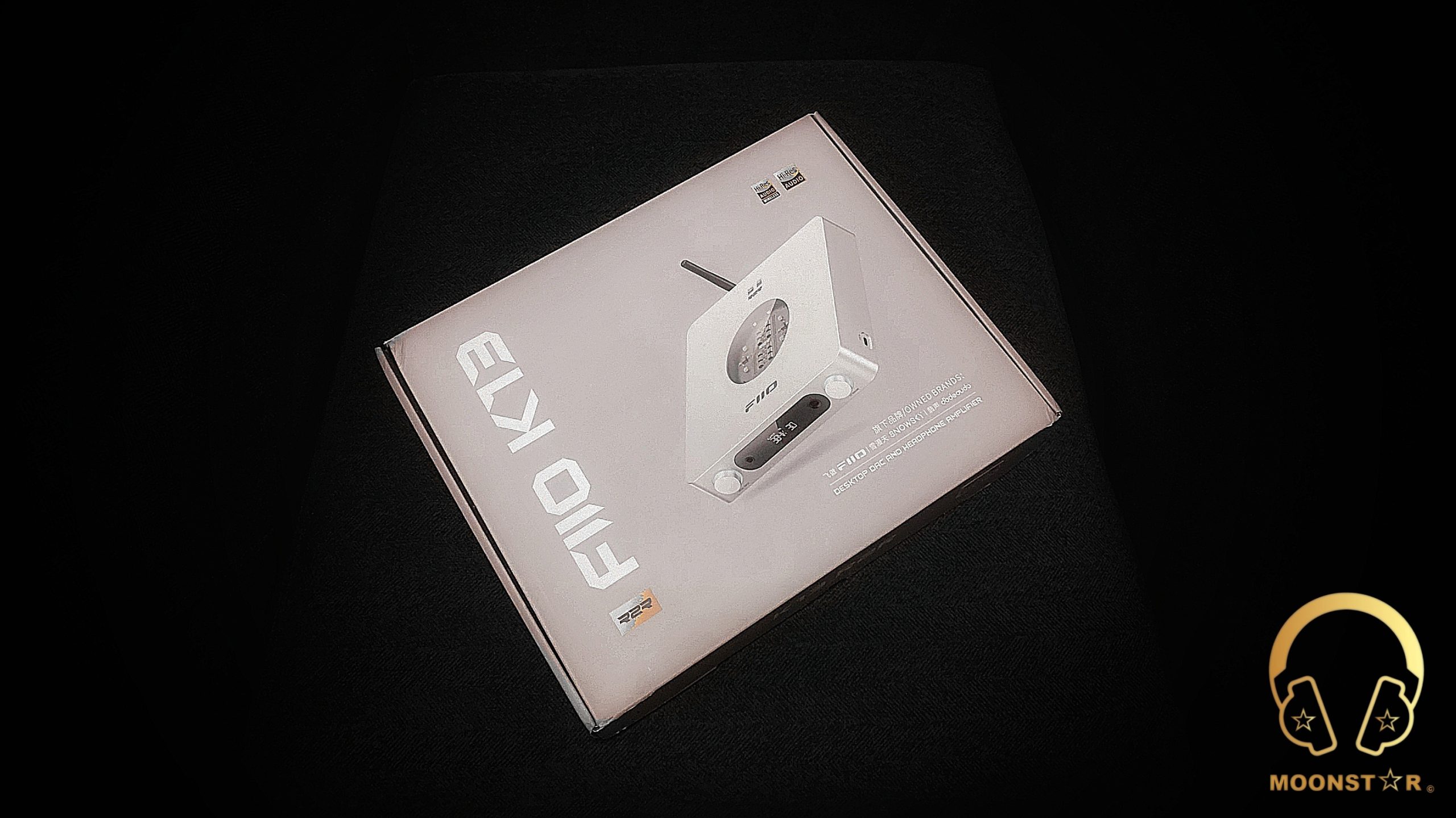
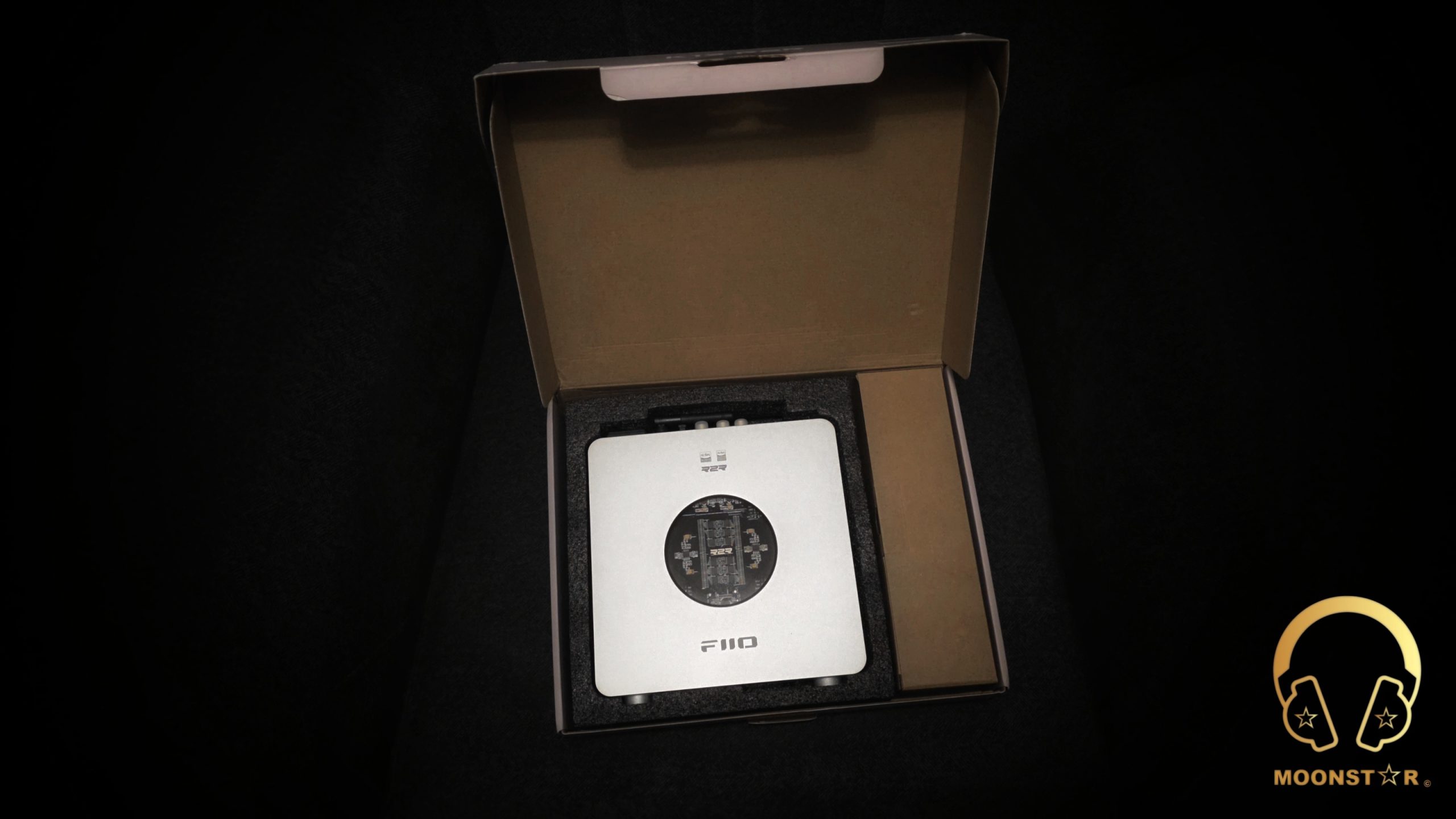
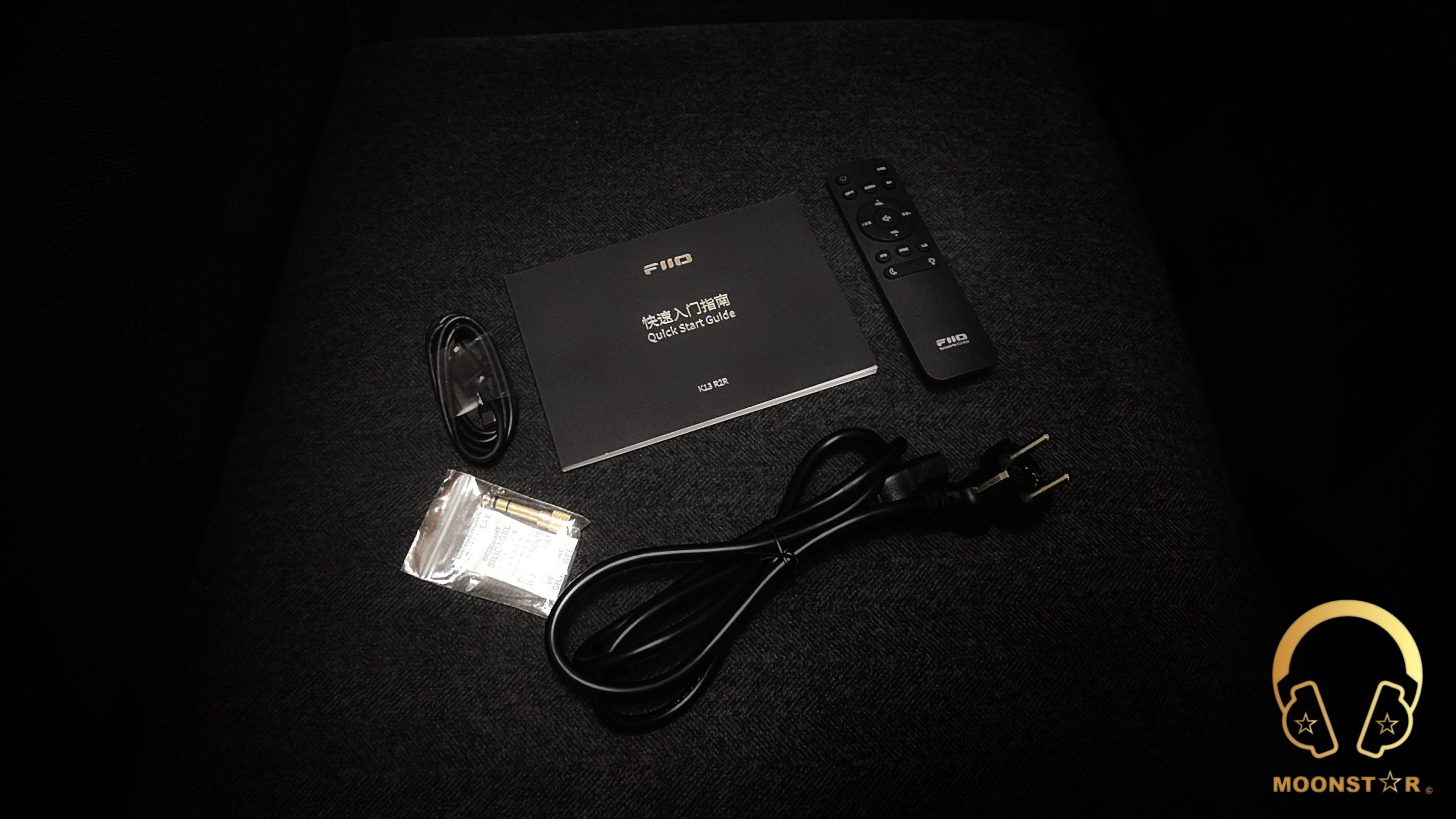
The box of the device contains the following items:
- 1 x FiiO K13 R2R Desktop DAC & Headphone Amplifier
- 1 x USB-A to USB Type-C Data Cable
- 1 x Power Cable
- 1 x 6.35mm Headphone Adapter
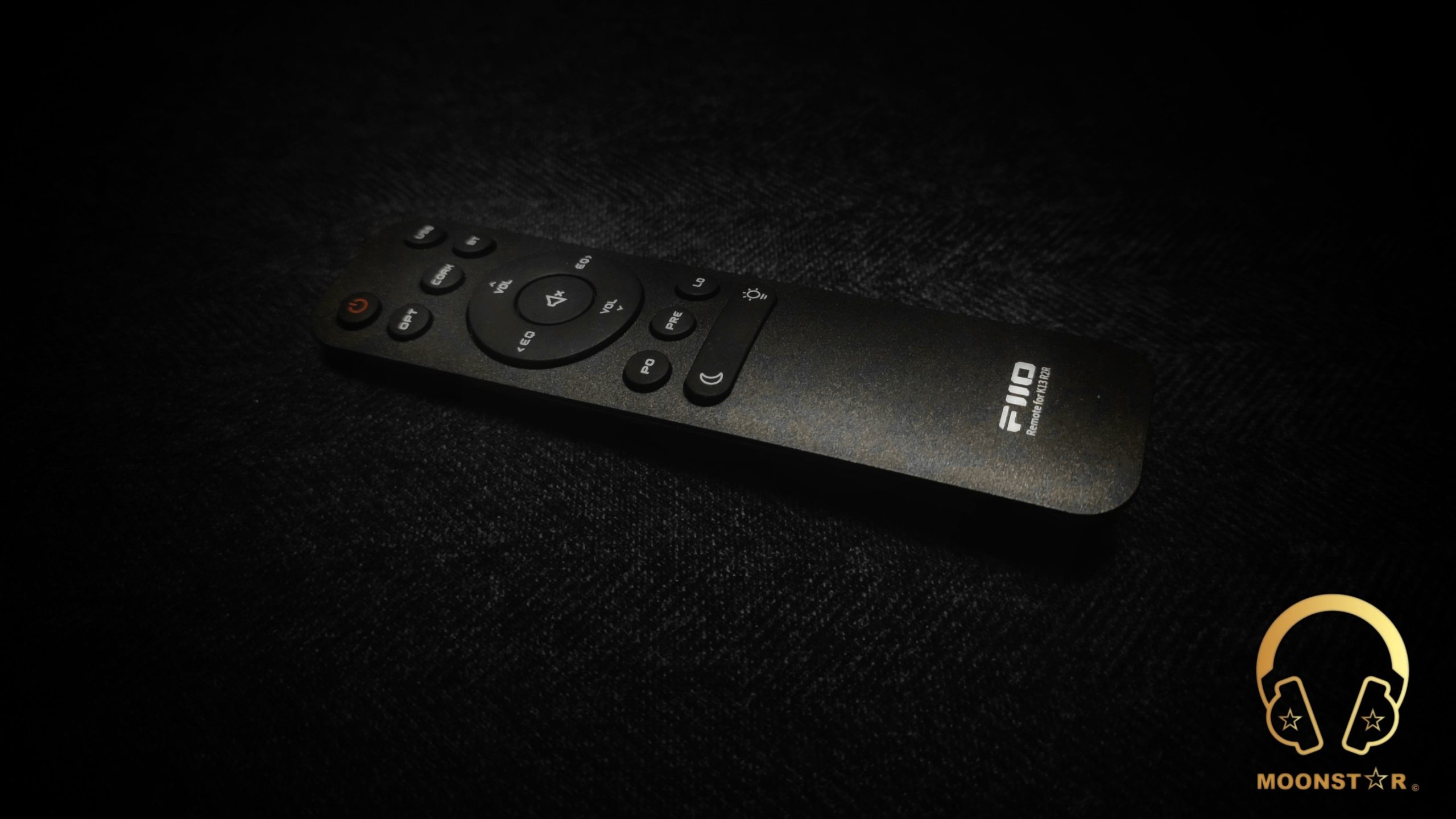
- 1 x Remote Control
- 1 x User Manual & Warranty card
Design & Build Quality:
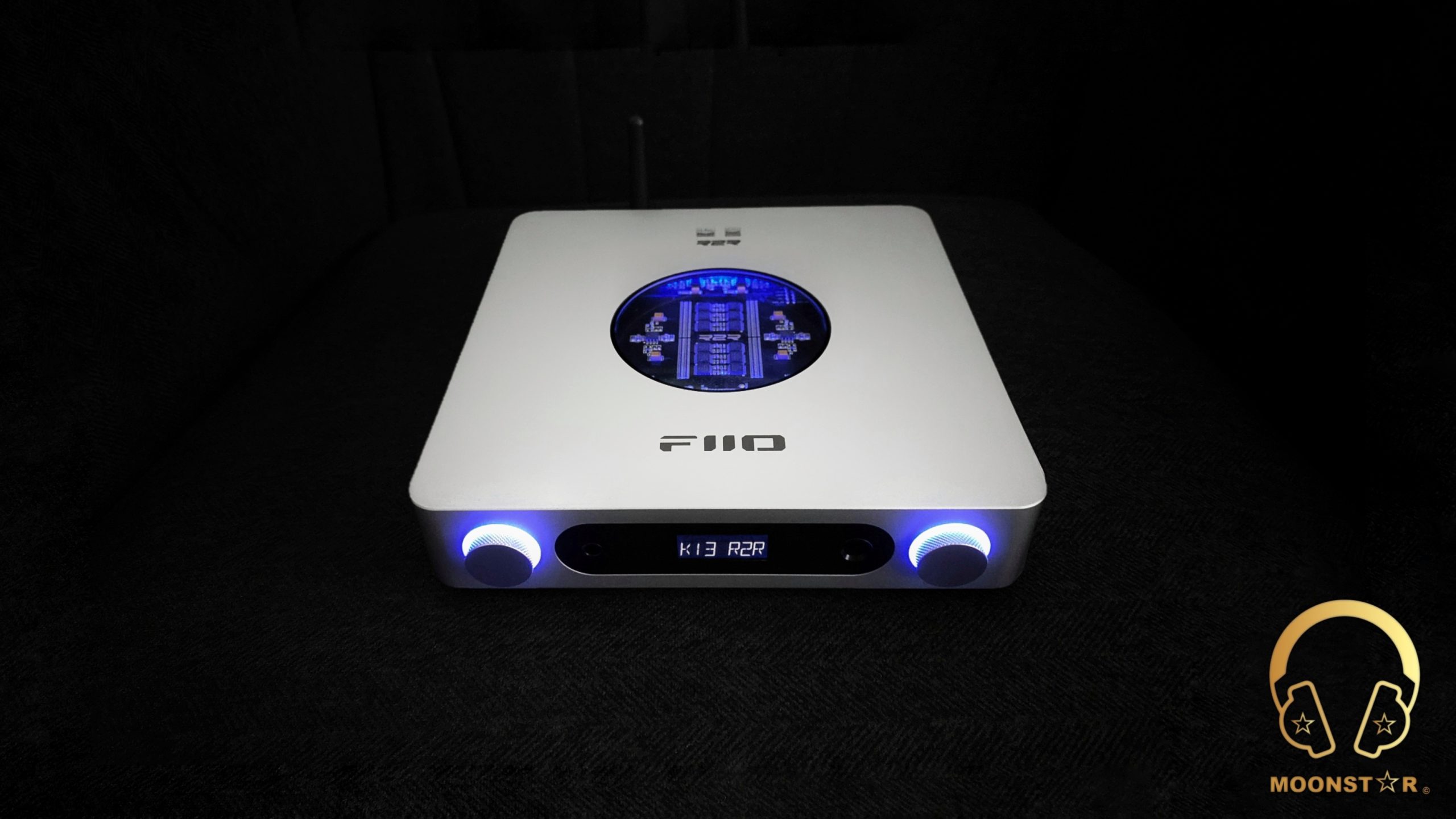
The FiiO K13 R2R utilizes an industrial design featuring an enclosure constructed entirely from aluminum. This material choice contributes to the unit’s build quality and physical specifications: the device has an approximate weight of 980g and its dimensions are 210 x 188 x 42 mm (including the integrated feet).
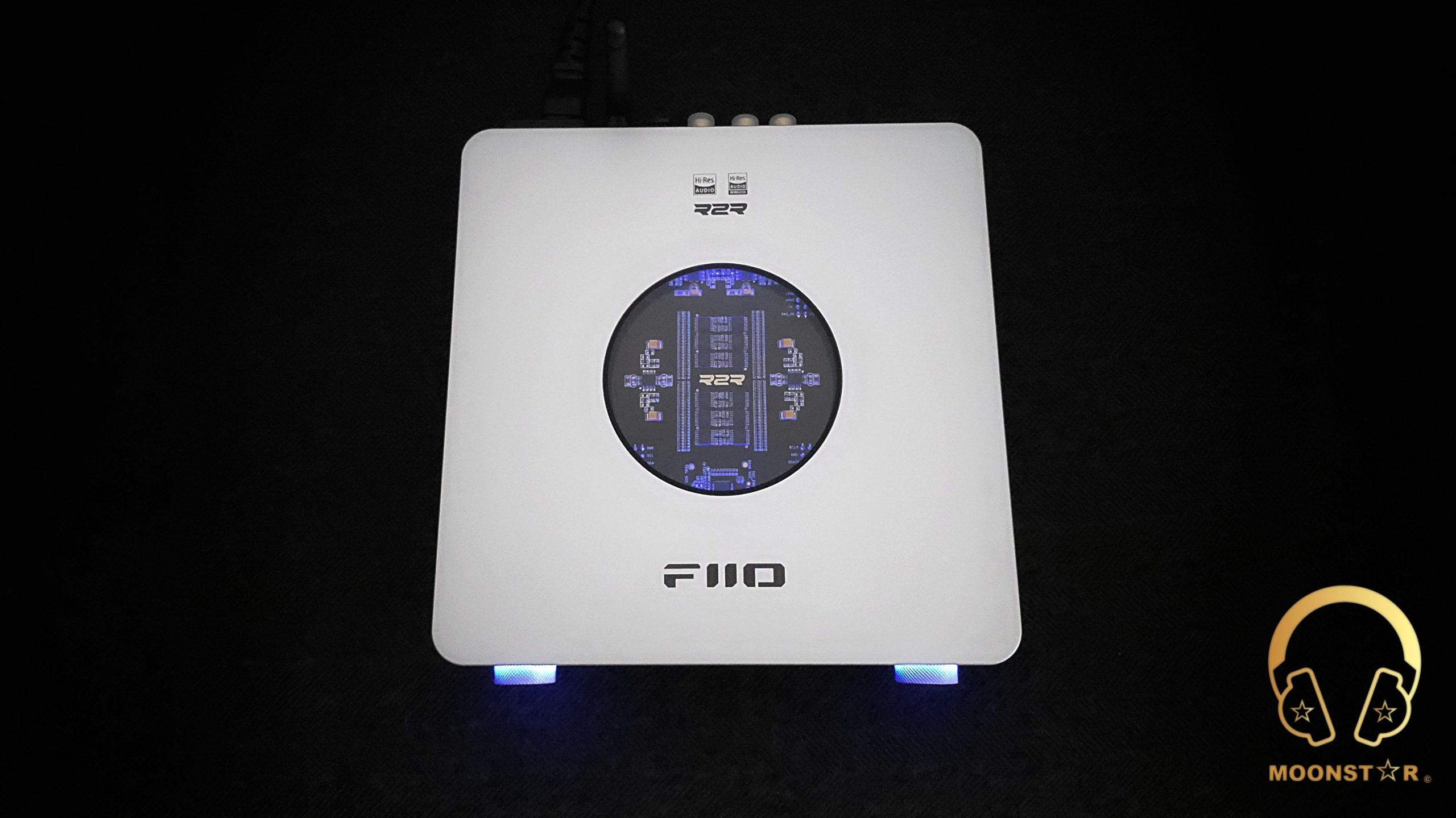
This substantial mass is functional, ensuring the unit maintains stability on the desktop during operation. This stability is critical when manipulating the size of the volume and menu knobs. Furthermore, the metal construction provides effective electromagnetic shielding. The unit’s dimensions are optimized for desktop placement, fitting into standard workstation environments.
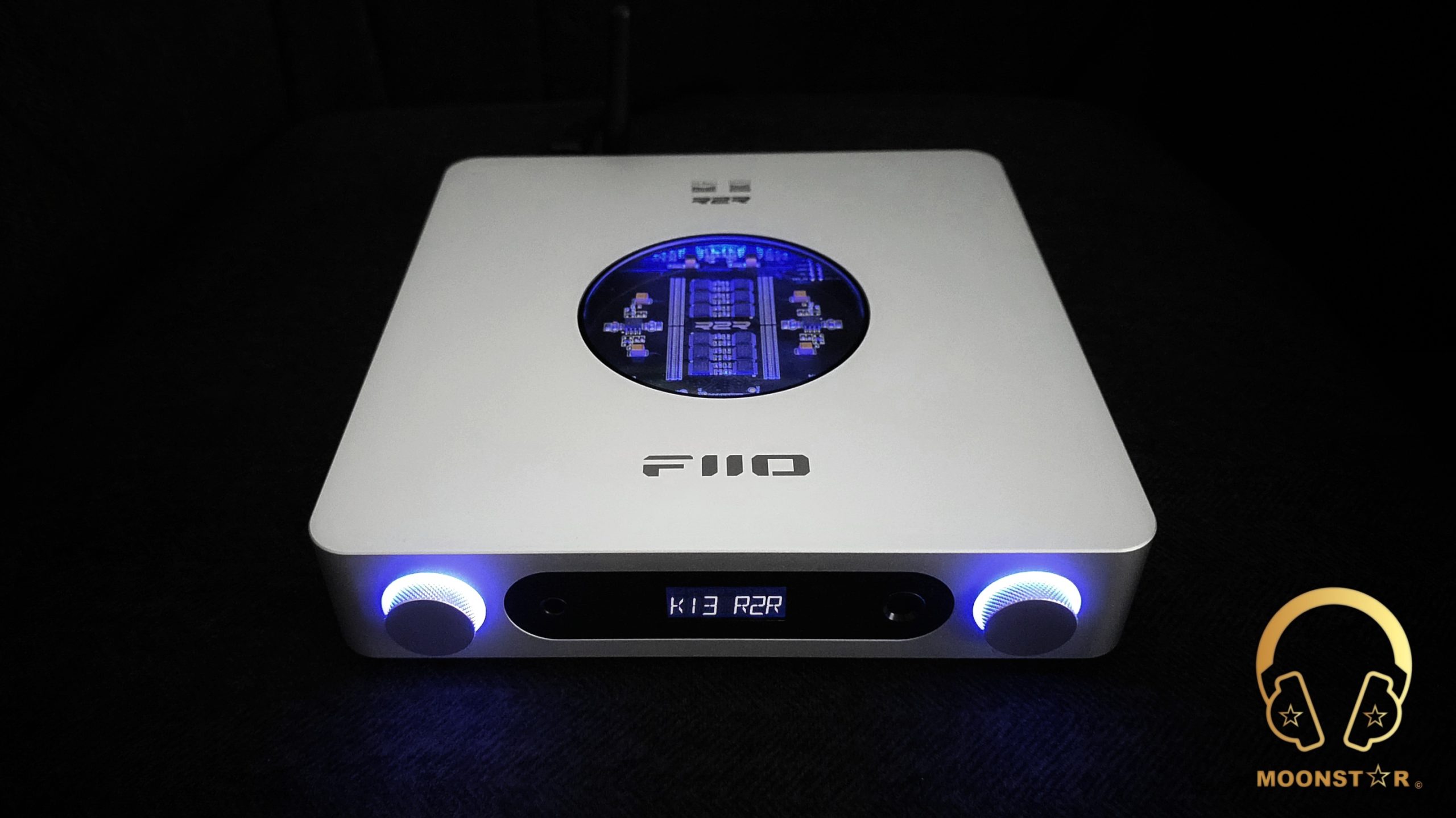
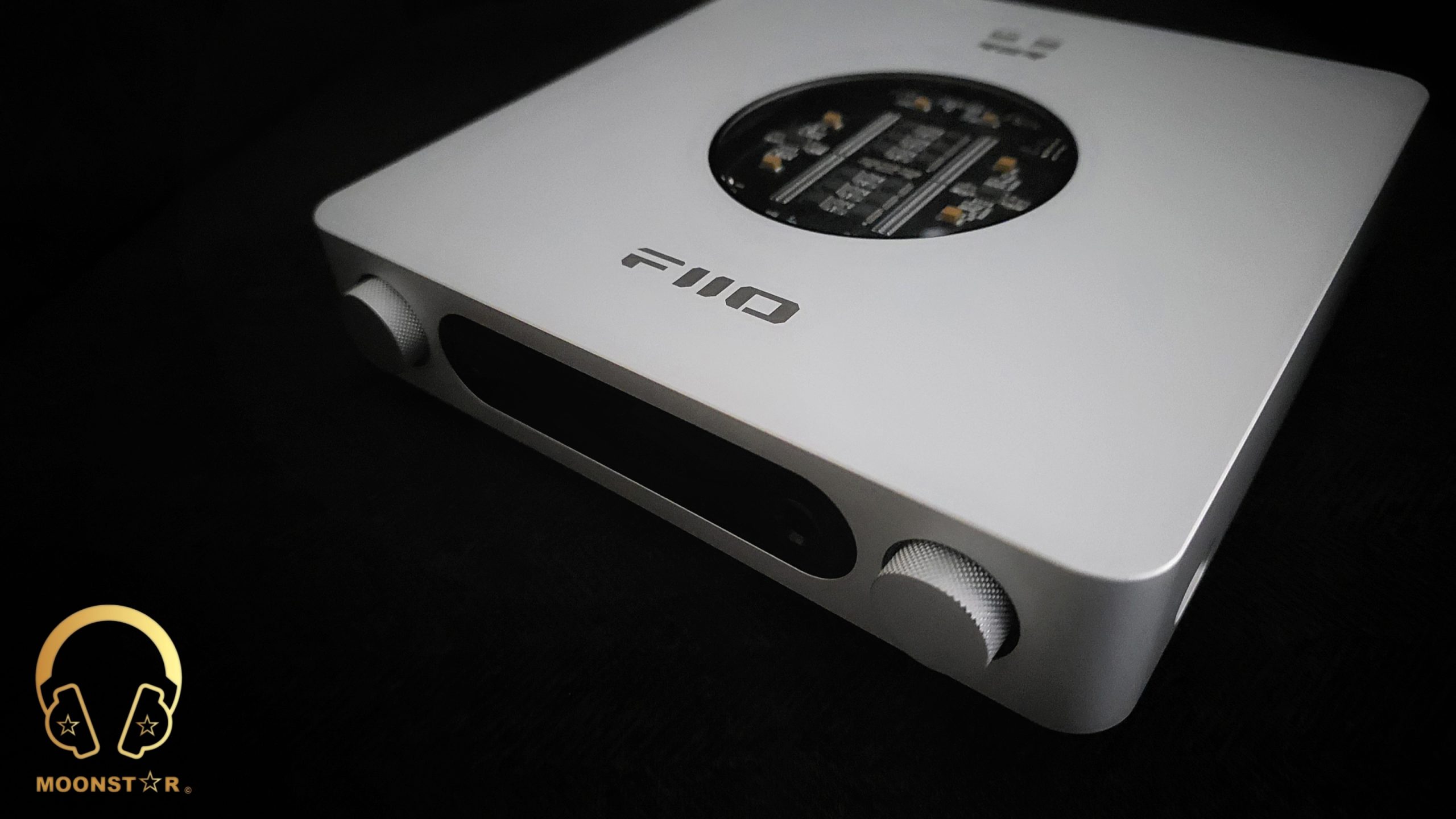
The FiiO logo is also prominently featured both on the top window’s periphery and on the front of the main chassis, reinforcing the brand identity. The overall feel is one of durability and meticulous construction, ensuring the K13 R2R looks professional in any desktop environment.
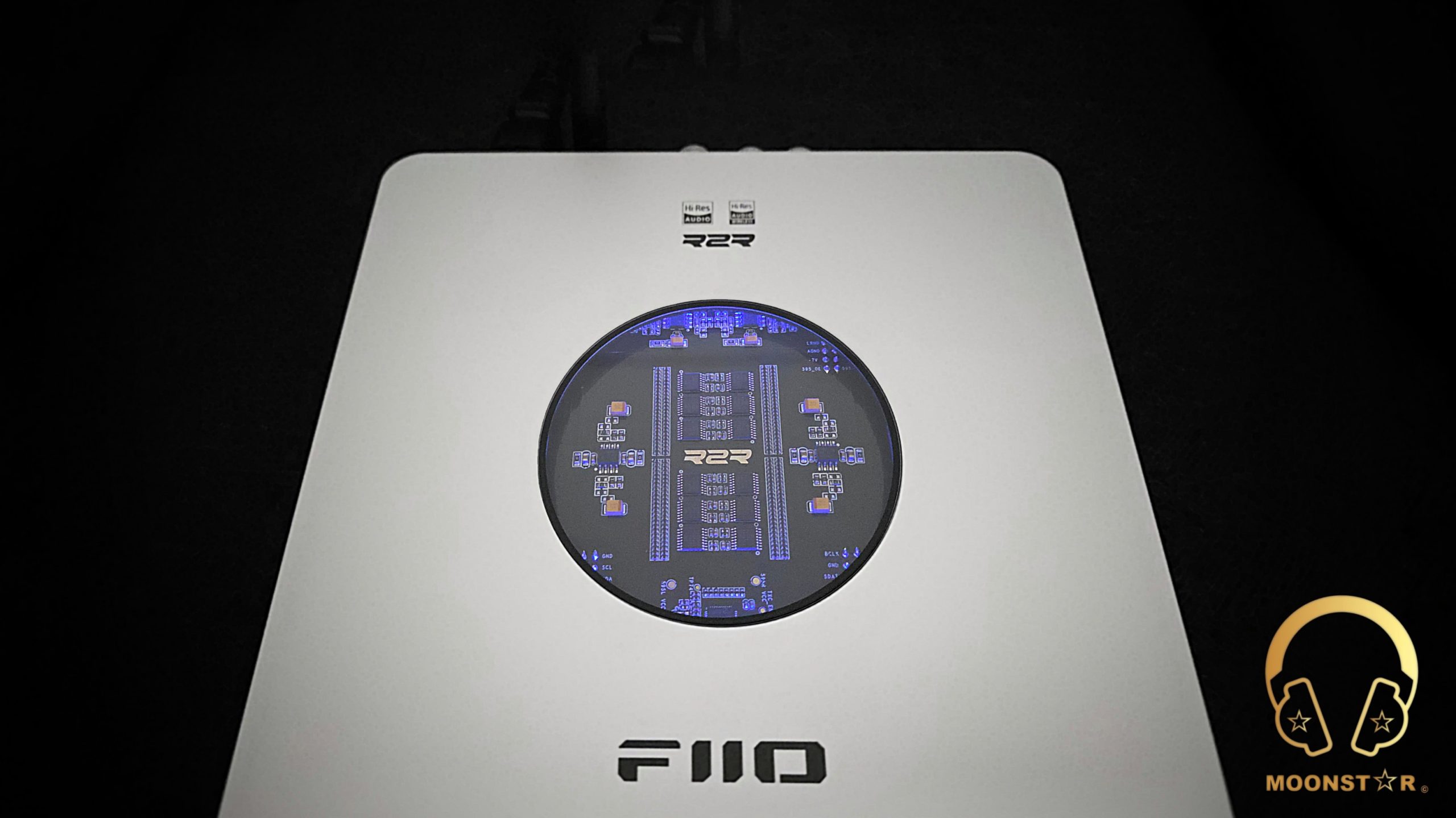
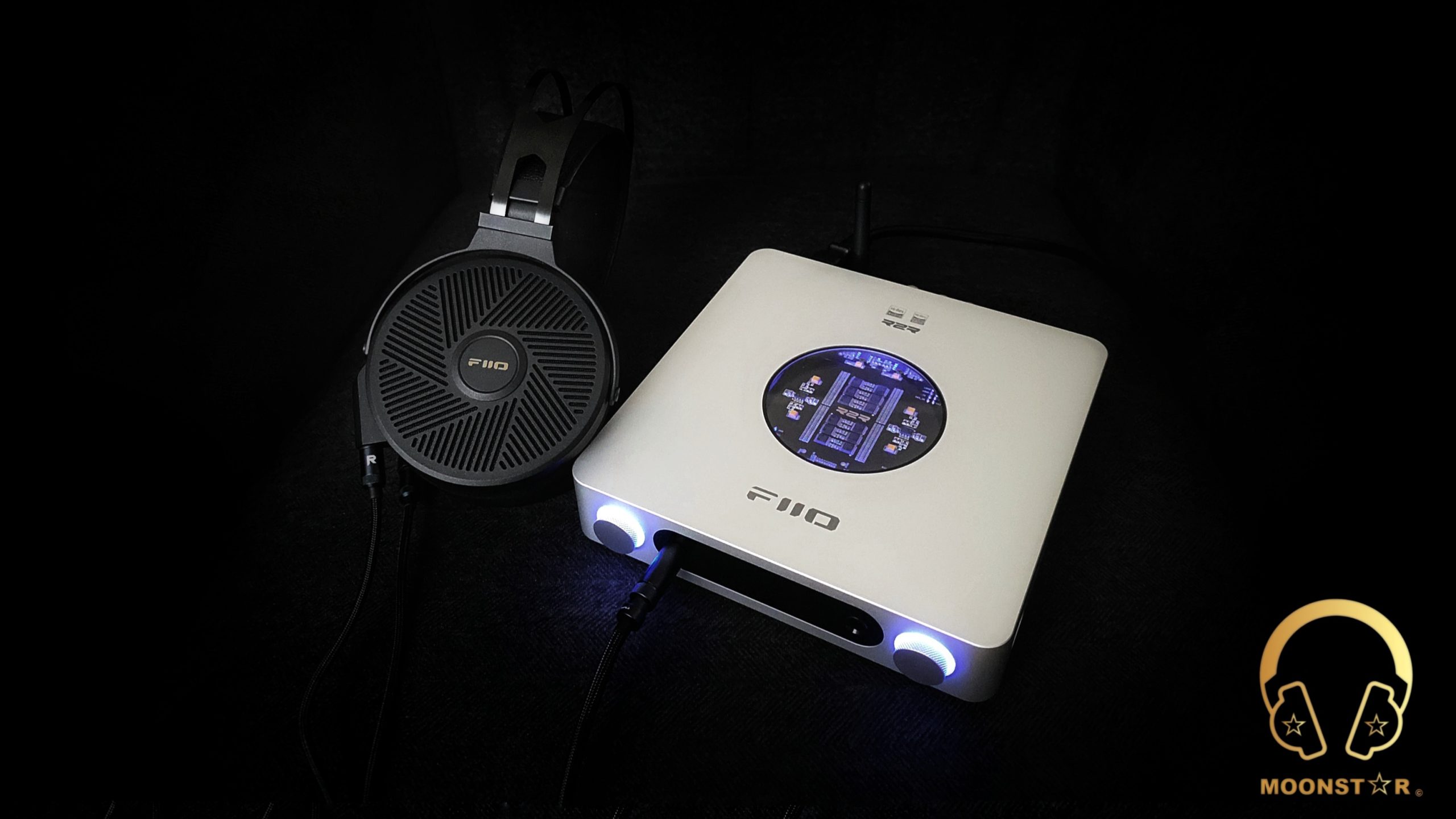
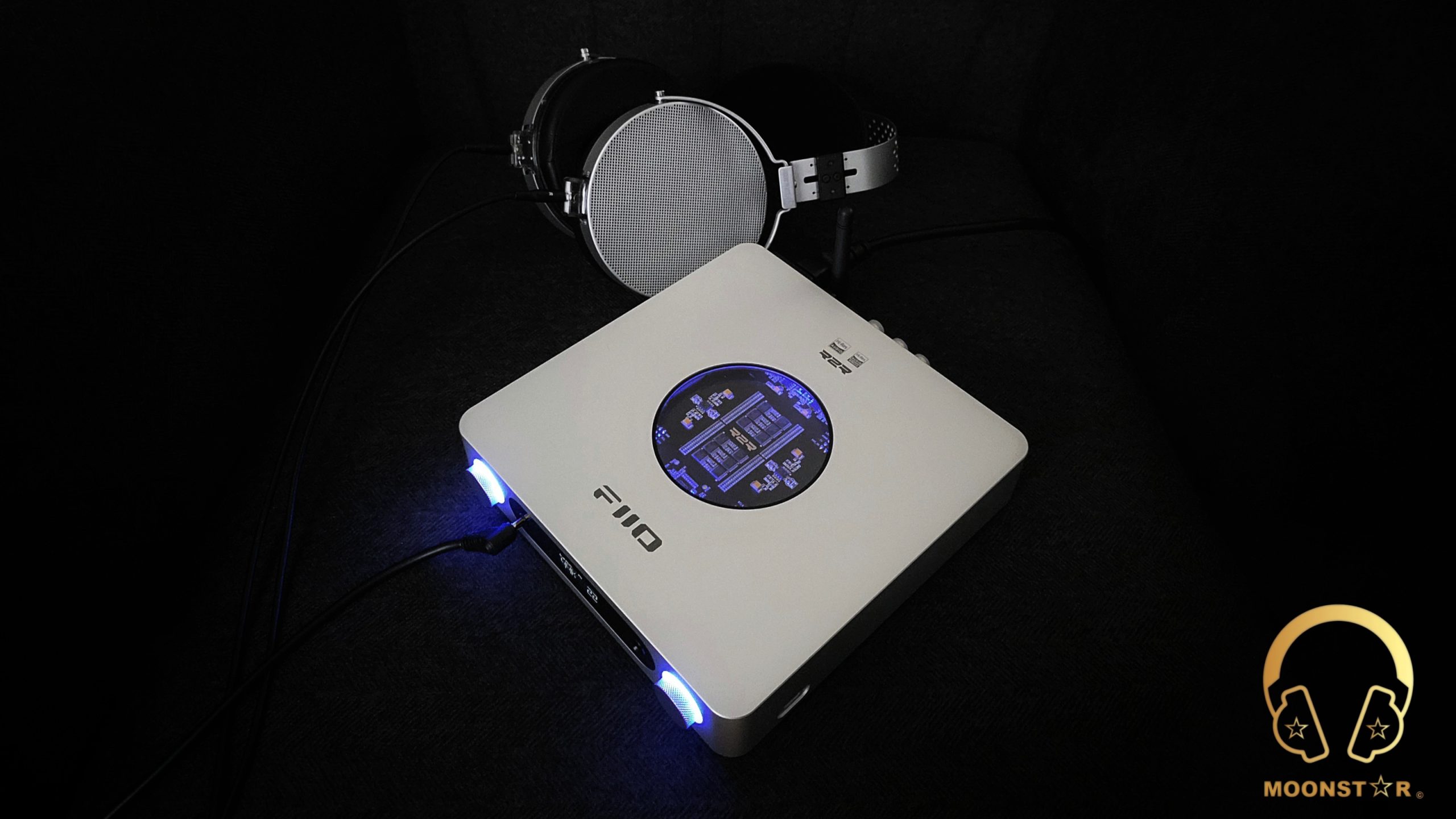
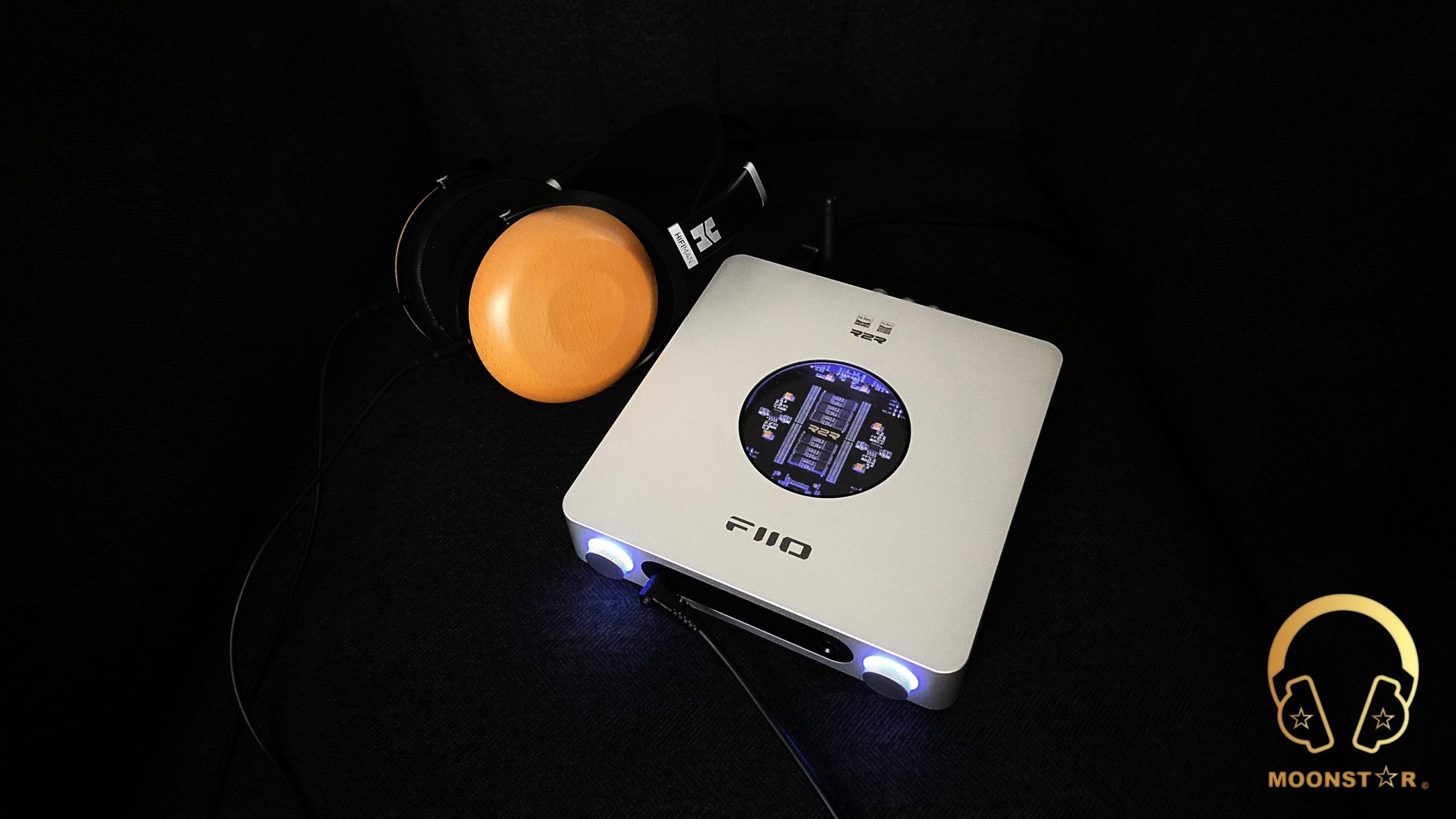
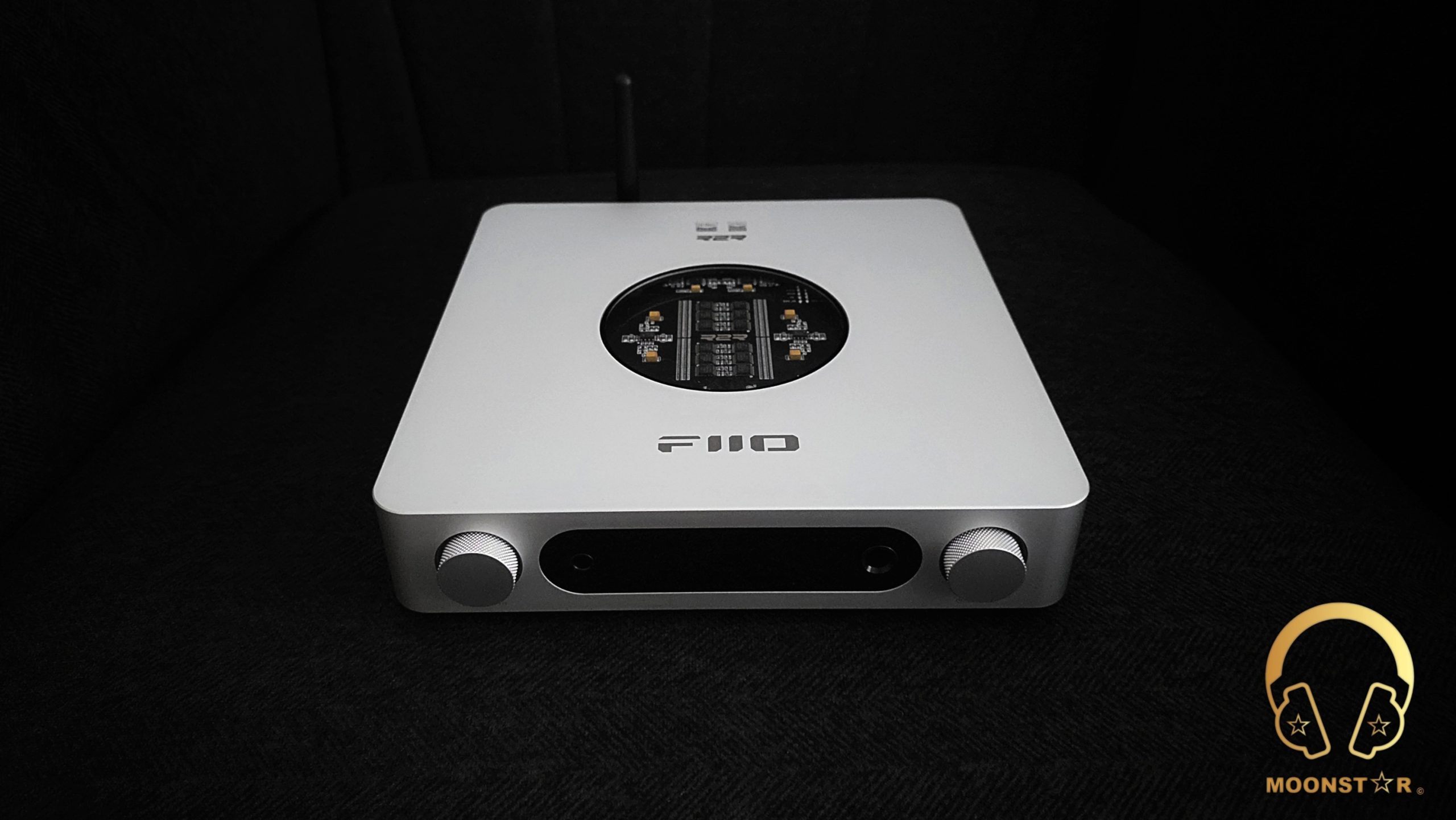
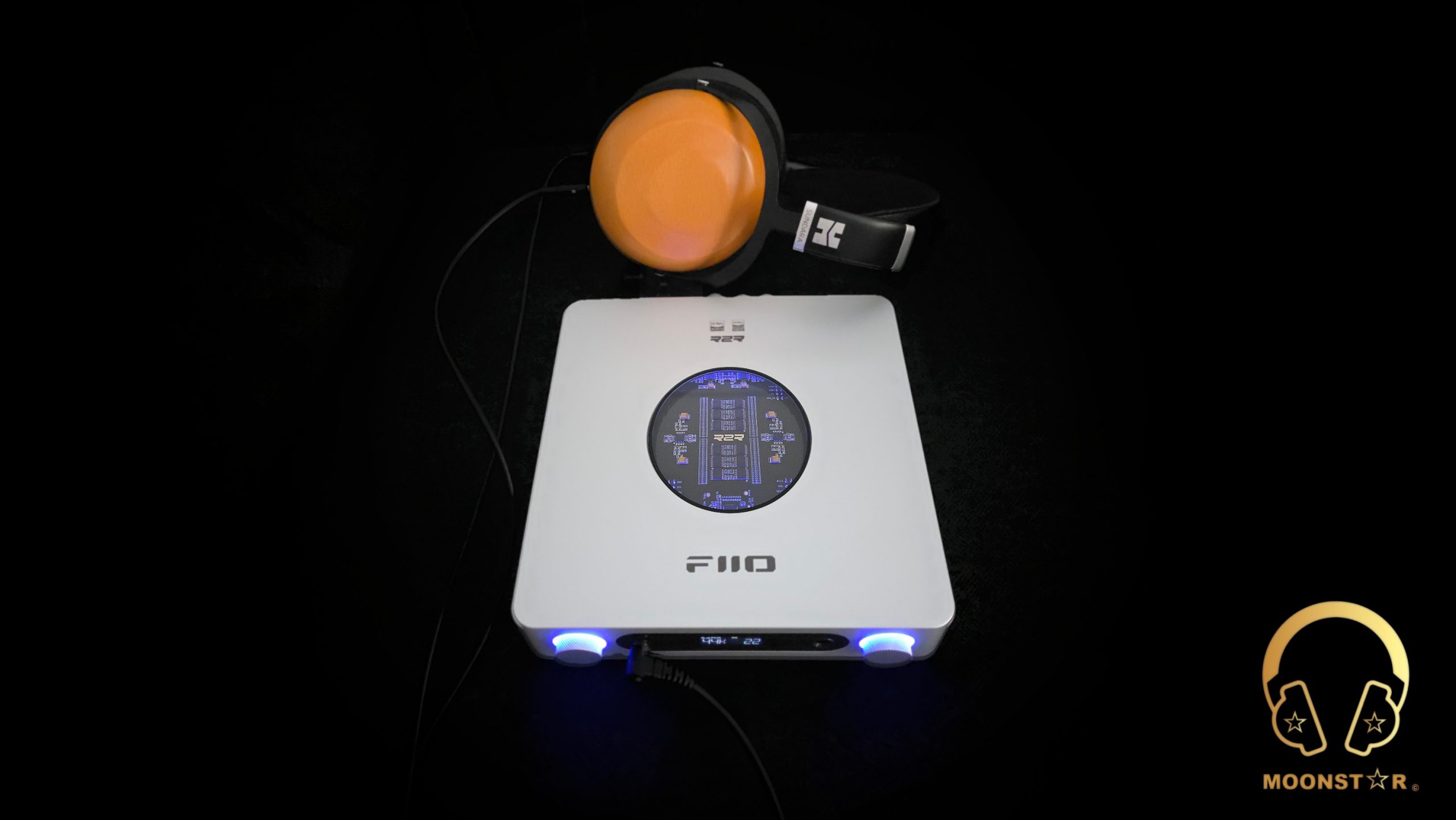
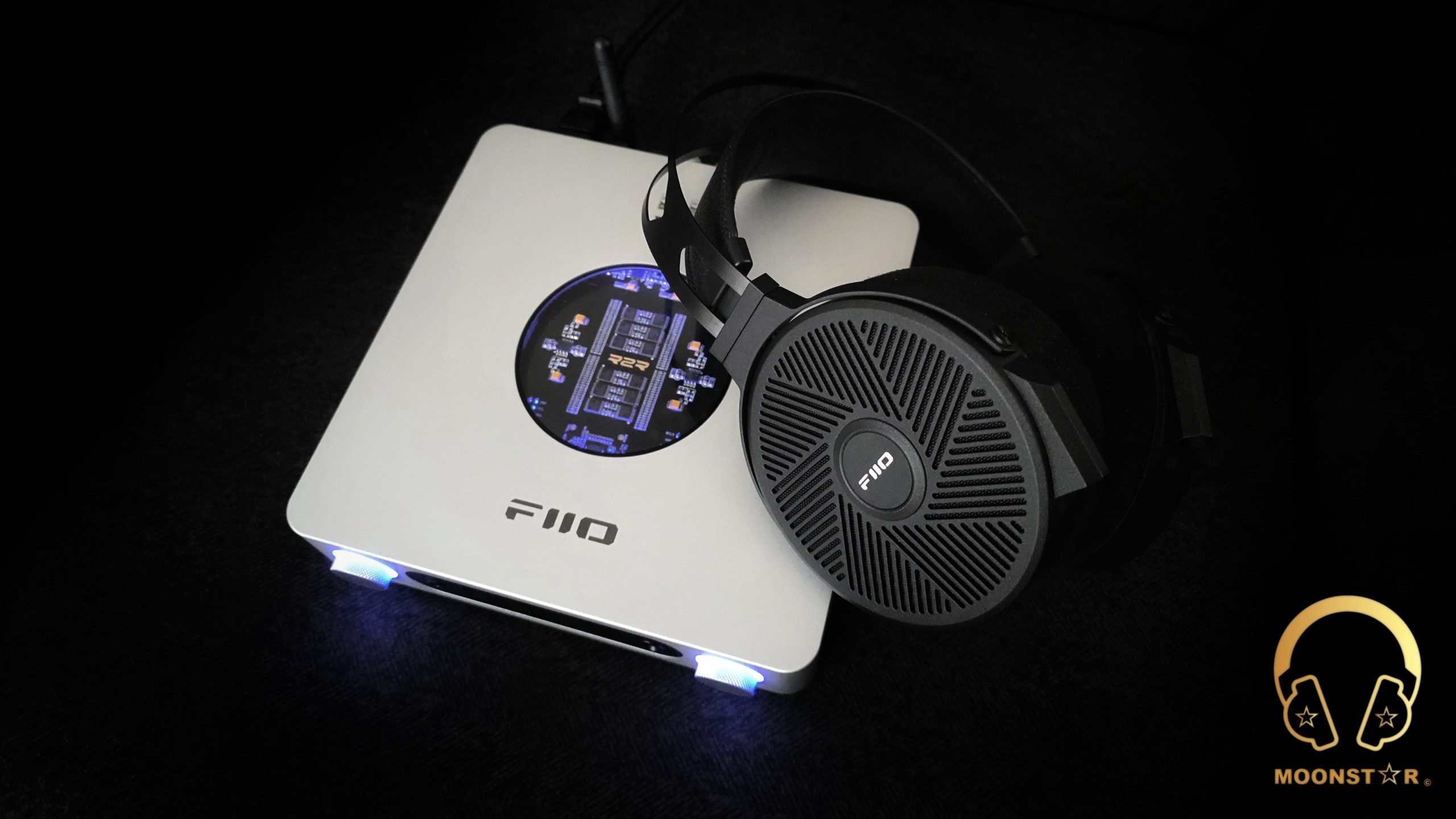
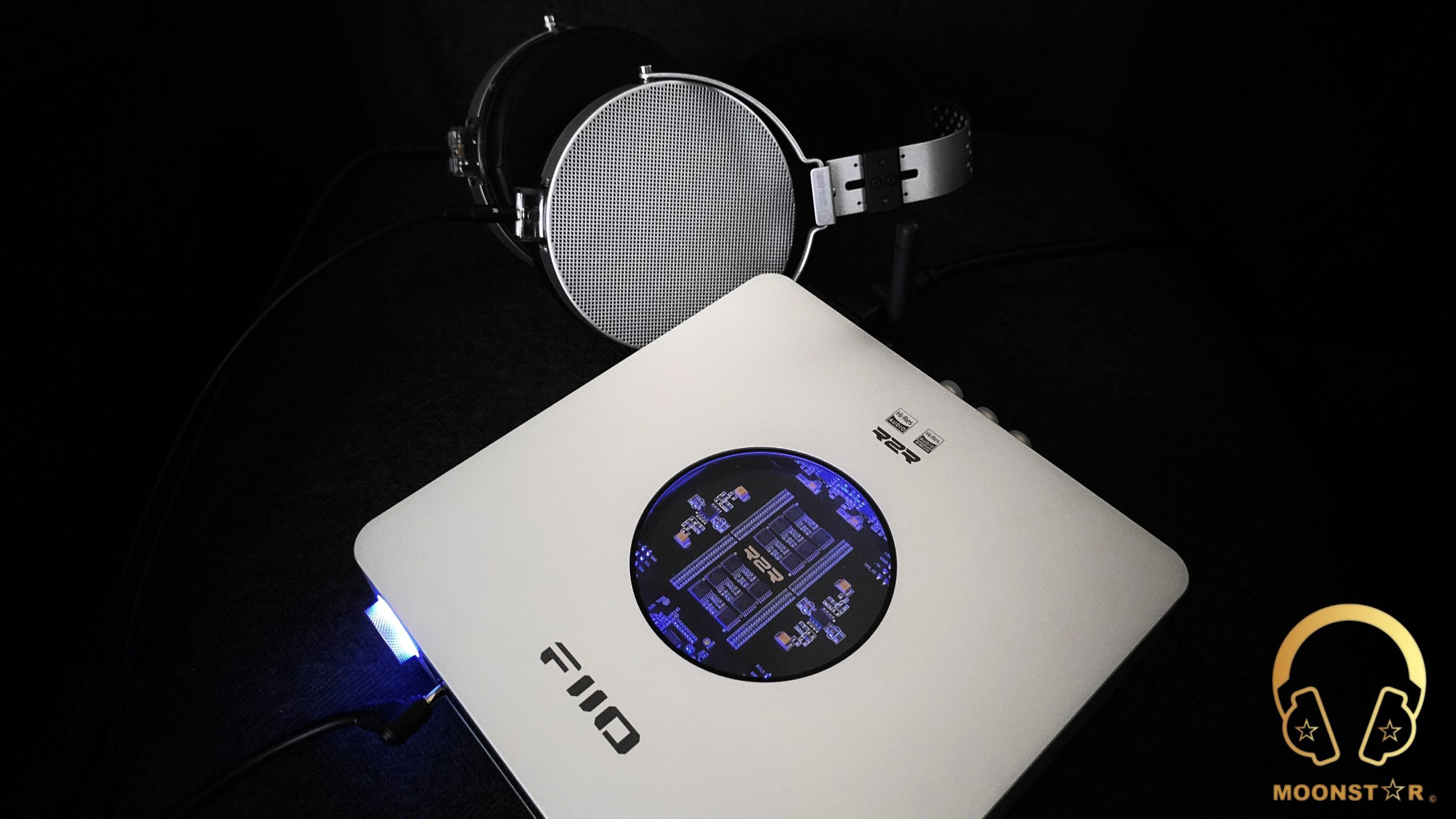
Visually, the most captivating feature is the circular viewing window located on the top panel. This ‘skylight’ offers a direct and often illuminated view of the discrete R2R resistor network printed on a specialized circuit board inside.
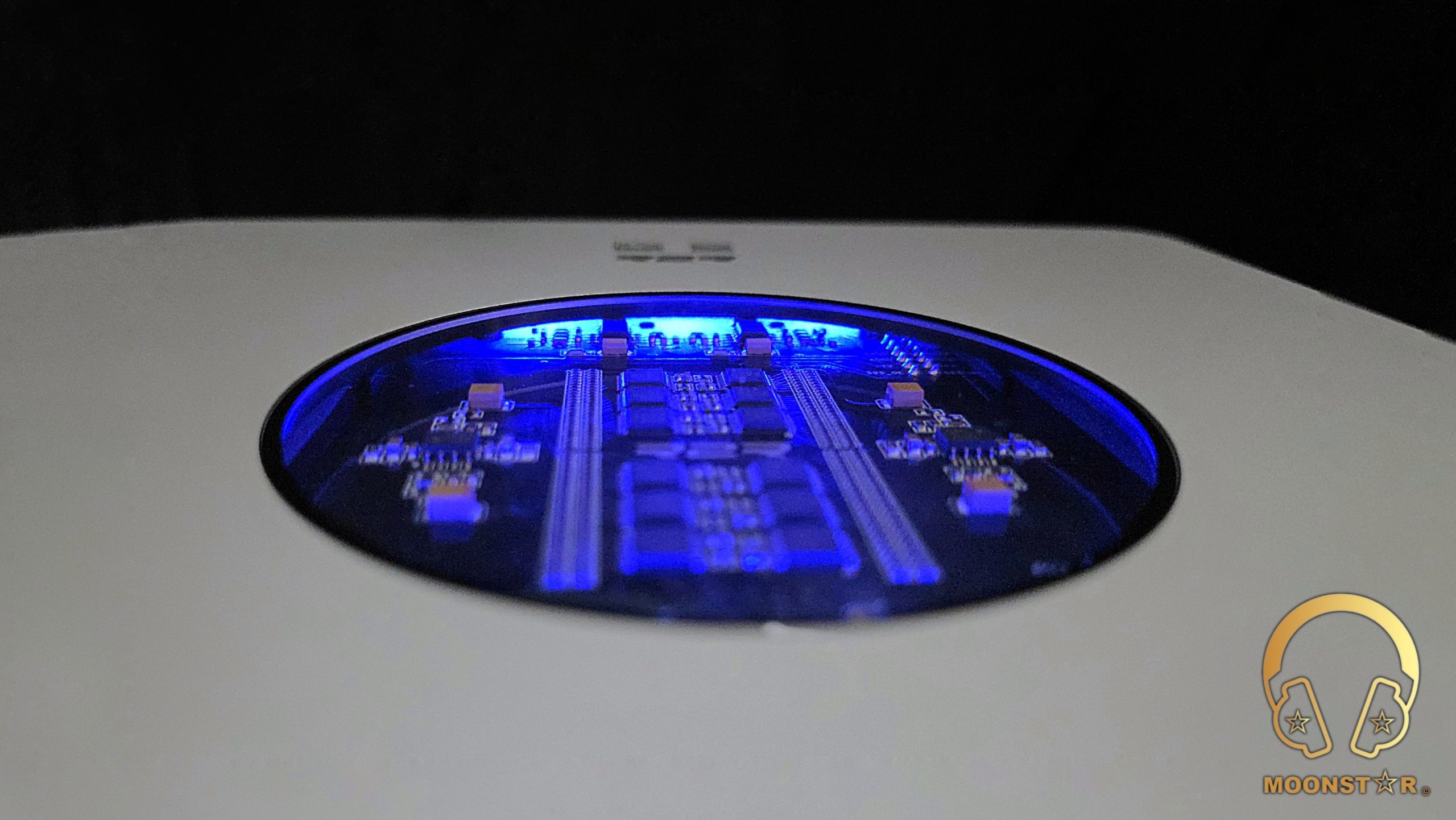
The visibility of the physical R2R structure, clearly branded with the ‘R2R’ logo and surrounded by the intricate circuitry, serves as a powerful visual confirmation of the technology at the device’s core.
The front panel layout prioritizes control access and information clarity. A central Display Screen presents key operational data, such as the current status, active input source, and detected sampling rates.
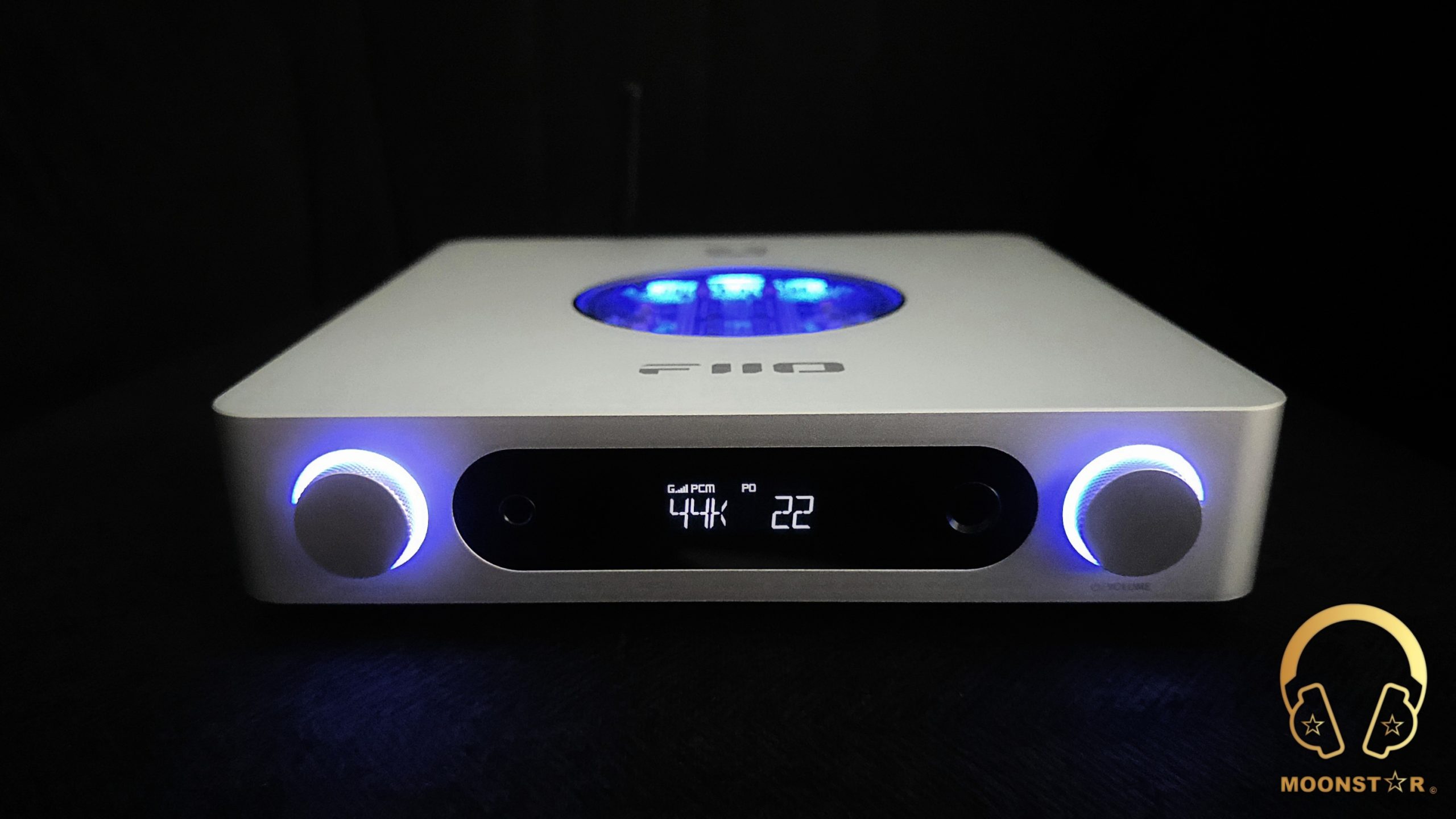
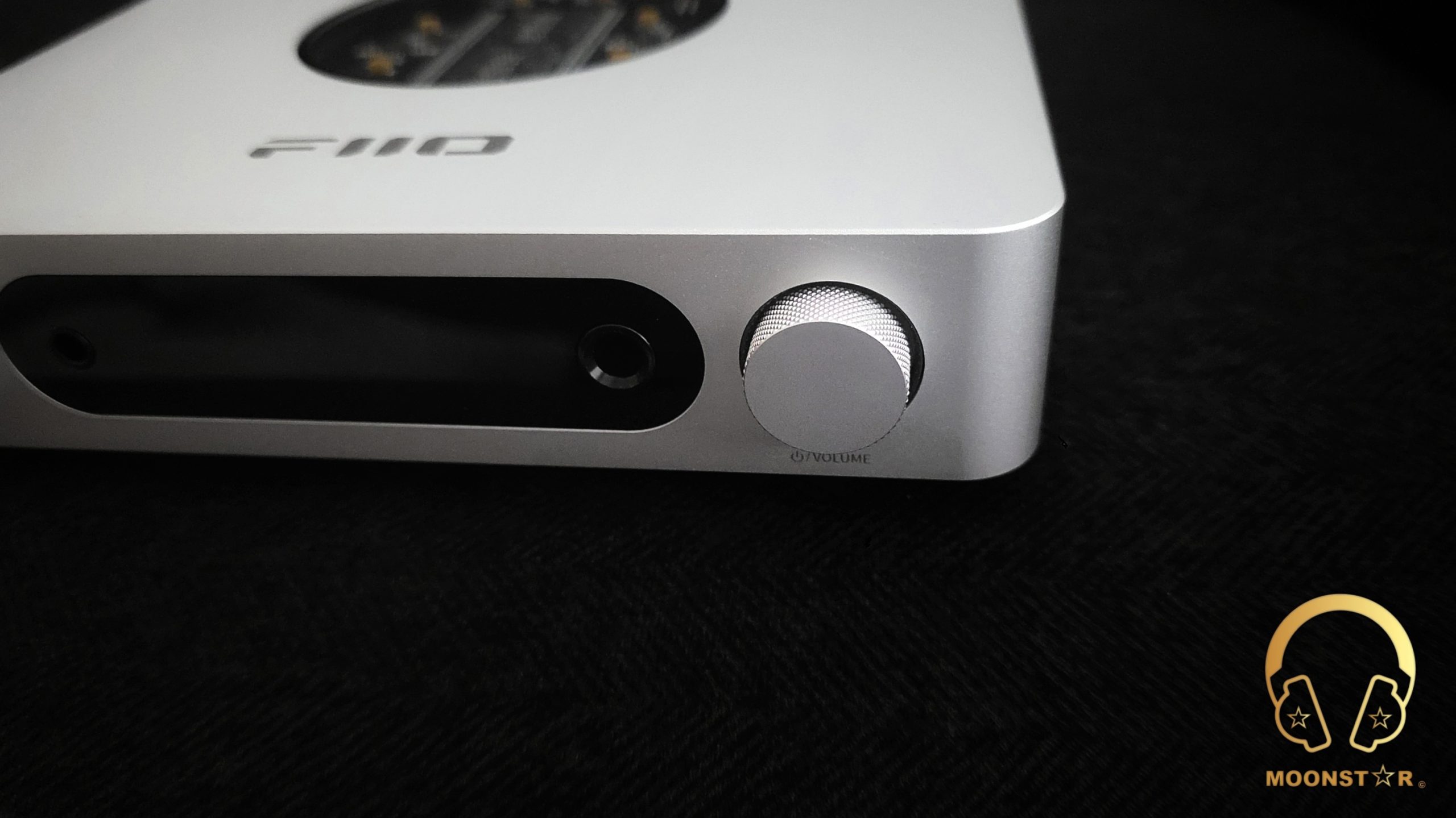
Physical controls consist mainly of two rotary encoders: the Menu Knob is placed on the left for settings navigation, and the larger Volume Knob is located on the right for output level adjustment.
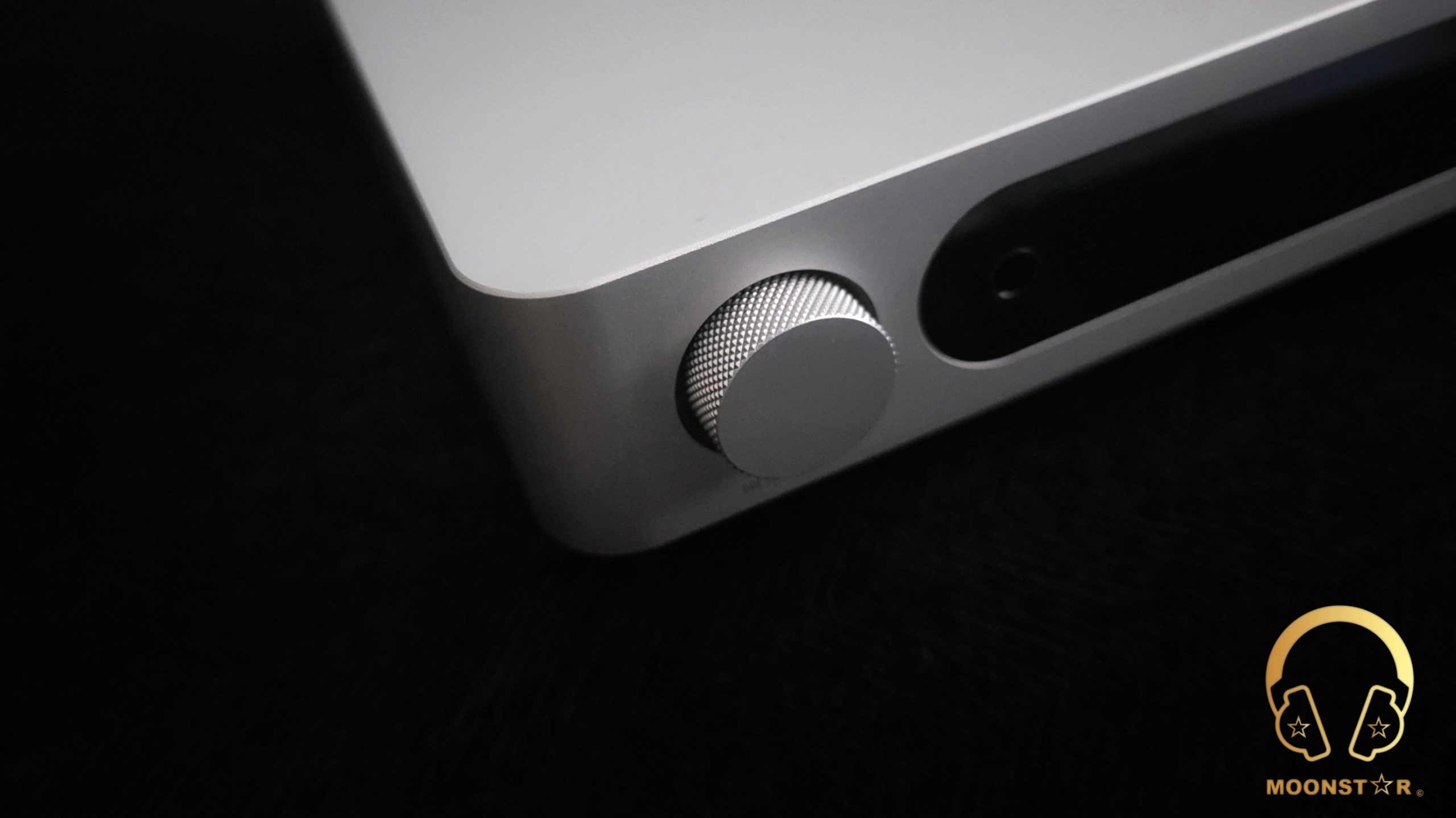 Headphone output flexibility is achieved through two standard connectors. A 6.35mm output handles standard single-ended headphone connections, while a 4.4mm balanced output is included to interface with headphones requiring the unit’s differential output configuration.
The rear and side panels house the physical connectivity interfaces of the K13 R2R.
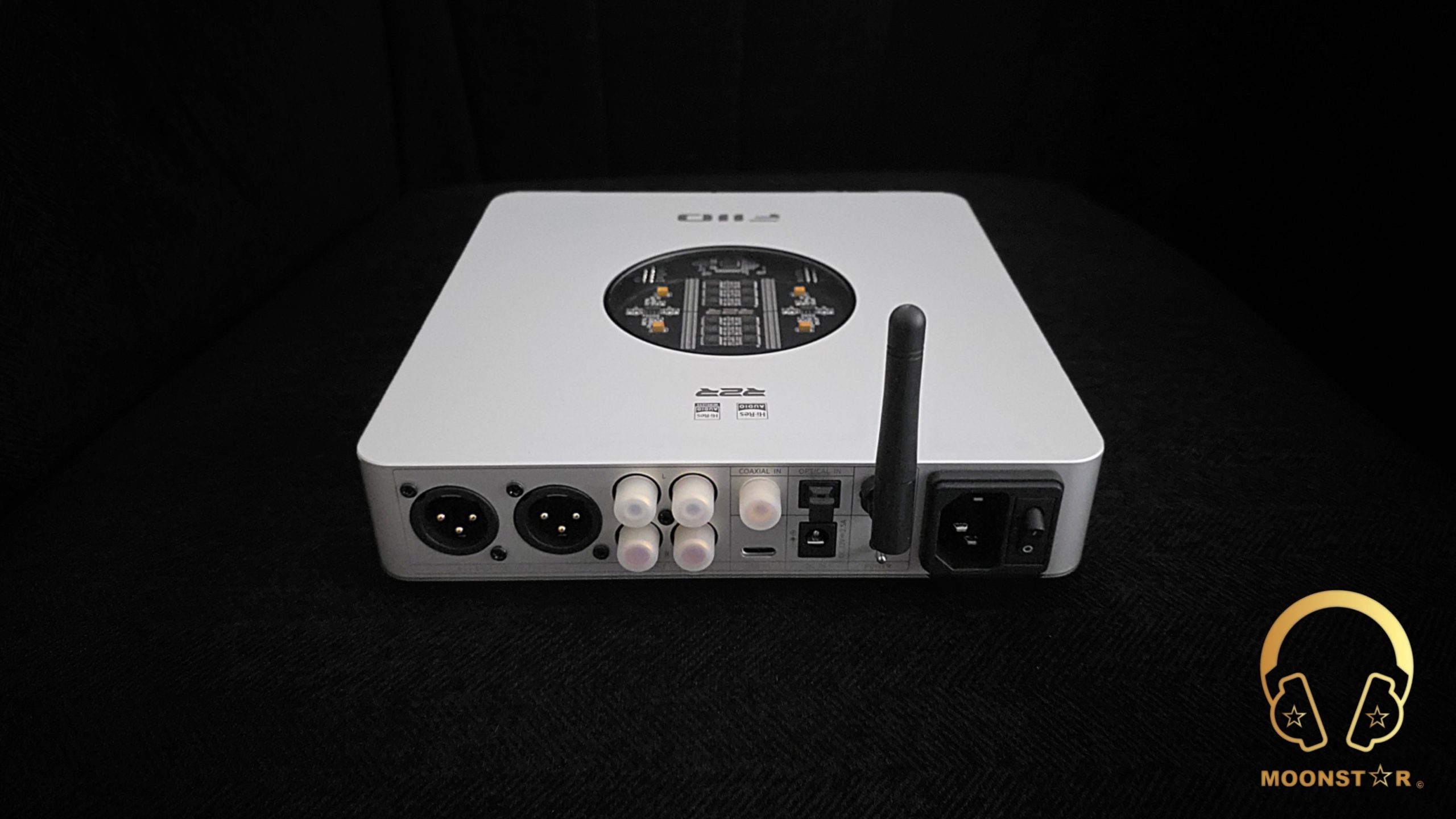
The rear panel integrates both analog and digital I/O options:
- Analog Outputs: Consist of a Balanced Line Output (XLR) and a Single-ended Line Output (RCA).
- Digital Inputs: Include Coaxial Input and Optical Input ports.
- Wireless: A connection point for the Bluetooth antenna is present.
- Power: The unit offers an AC Power Input for the internal supply and a DC Power Input (12V) for utilizing an external supply. An AC/DC Power Switch controls the selection between these two sources.
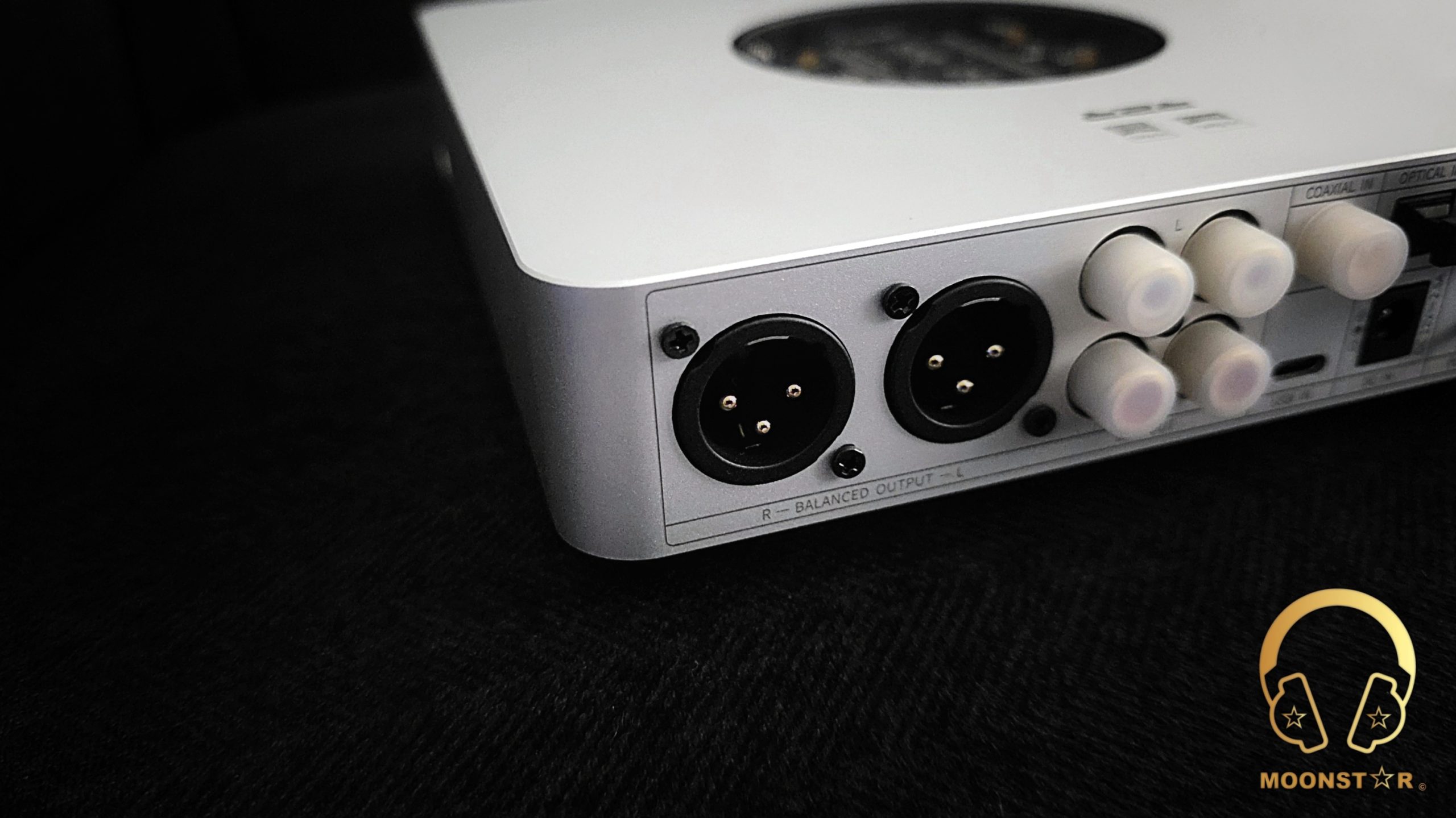
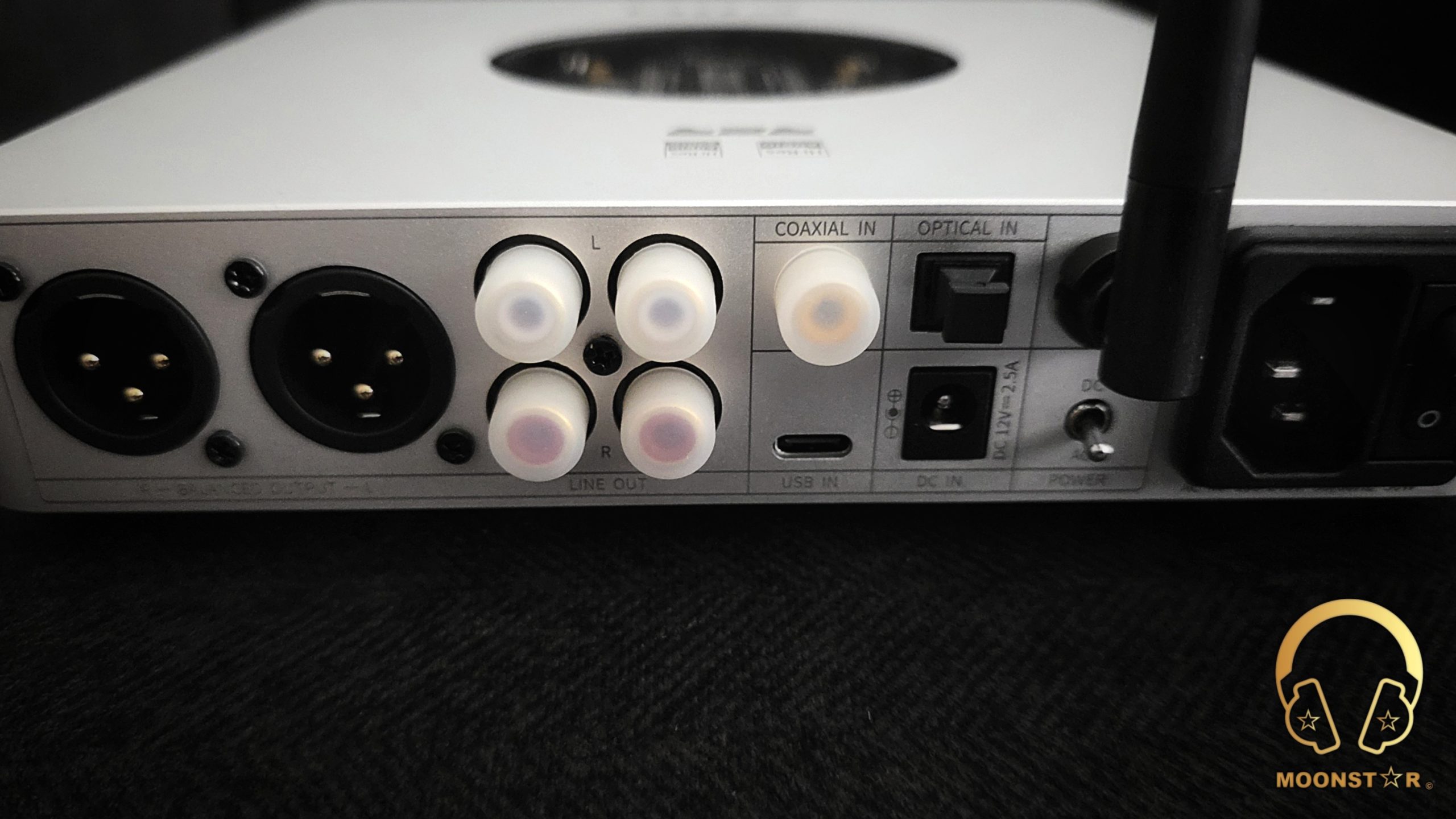
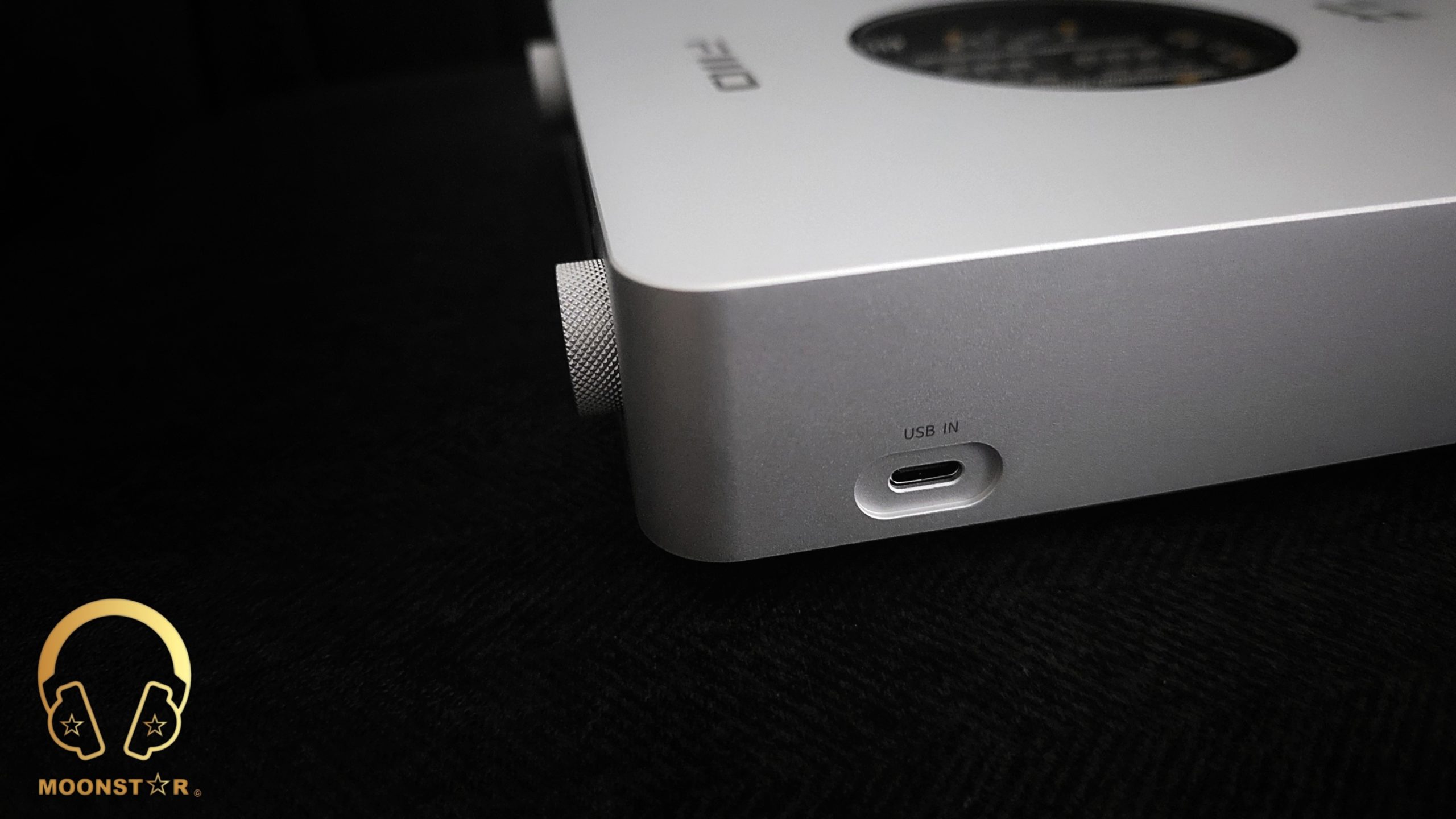
An additional USB Input is positioned on the side panel. Both USB ports function as decoding inputs. When both USB ports are connected simultaneously, the side USB port connection overrides the rear port, disabling its function. The side USB port is also designated for initiating Microcontroller Unit (MCU) firmware upgrades.
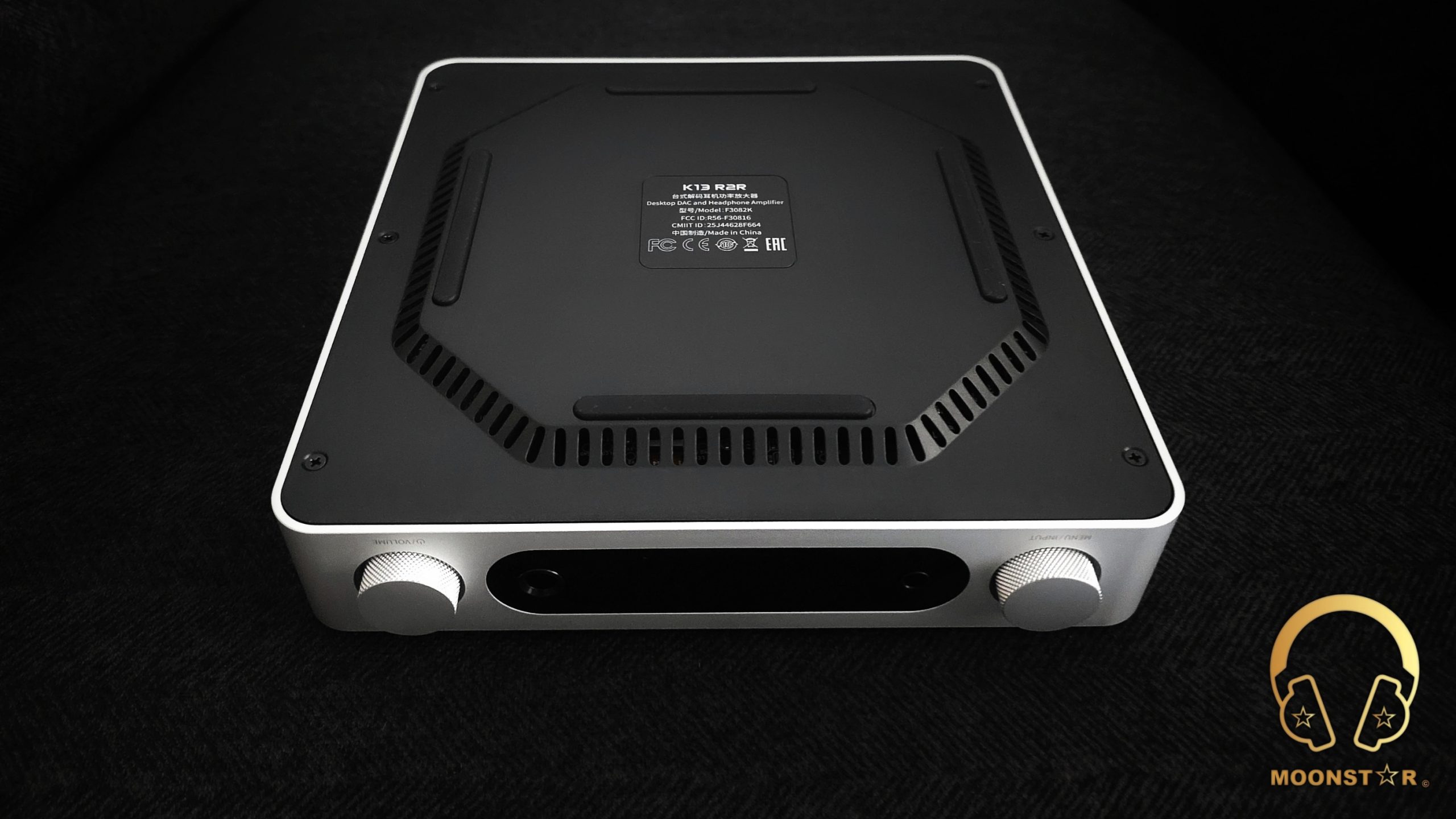
The bottom of the FiiO K13 R2R features a functional design focused on stability and thermal management. The black base plate is equipped with an array of ventilation grilles arranged in a pattern to facilitate heat dissipation for the internal components. For desktop security, the unit utilizes four longitudinal rubber feet that prevent sliding during operation. A central identification label provides the model name, regulatory certifications, and power specifications, while four corner screws secure the base to the main aluminum chassis.
Overall, the K13 R2R’s design is defined by its robust aluminum construction, providing stability and effective electromagnetic shielding, which is crucial for desktop use. The front panel offers clear, dedicated controls via the display and rotary encoders. A key visual element is the top-mounted window, which transparently confirms the discrete R2R technology at the core of the unit. Coupled with its comprehensive I/O array, including dual USB ports and XLR outputs, the K13 R2R presents a highly functional and well-engineered physical package.
Technical Specifications:
- Model: K13 R2R
- Main control chip (MCU): ESP32-S3
- USB chip: XMOS XU316
- DAC: Fully differential true 24Bit R2R DAC resistor arrays
- Volume control chip: NJW1195AV
- R2R and LPF op-amp: OPA1642*4
- LO buffer op-amp: LTA8092*2
- Headphone amplifier: OPA16422 + TPA6120A2
- USB input: 384KHz/32bit, DSD256
- Coaxial input: 192KHz/24bit, DSD64
- Optical input: 192KHz/24bit
- USB connector: Dual Type-C
- Display: Custom LCD
- Power input: AC 100-240V 50/60Hz; DC 12V/2.5A
- Dimensions: About 210x188x42mm (including feet)
- Weight: About 980g
- Single-ended power output 1: L+R≥1220mW +1220mW (32Ω, THD+N <1%) (32Ω/SE/high gain)
- Single-ended power output 2: L+R≥150mW +150mW (300Ω, THD+N <1%) (300Ω/SE/high gain)
- Balanced power output 1: L+R≥2400mW +2400mW (32Ω, THD+N <1%) (32Ω/balanced/high gain)
- Balanced power output 2: L+R≥600mW +600mW (300Ω, THD+N <1%) (300Ω/balanced/high gain)
- Frequency response: 20Hz~80kHz; Attenuation < 2.9dB
- SNR: ≥116dB (A-weighted)
- Noise floor: PO < 5uV (A-weighted, M gain); BAL < 8uV (A-weighted, M gain)
- Output impedance: PO < 0.7Ω (32Ω load); BAL < 1Ω (32Ω load)
- THD+N: About 0.0173% (1kHz/-6dB@32Ω)
Features & Hardware Overview:
The FiiO K13 R2R is engineered around a discrete R2R ladder architecture to manage digital-to-analog conversion, supported by substantial output capability and modern connectivity features. The core device component is the fully differential 24-bit R2R DAC. This architecture deviates from conventional integrated Delta-Sigma chips by utilizing a precisely matched discrete resistor network for conversion. This configuration is known to influence the sound profile by offering specific characteristics such as harmonic complexity and nuanced decay, often resulting in a presentation perceived as closer to an analog source.
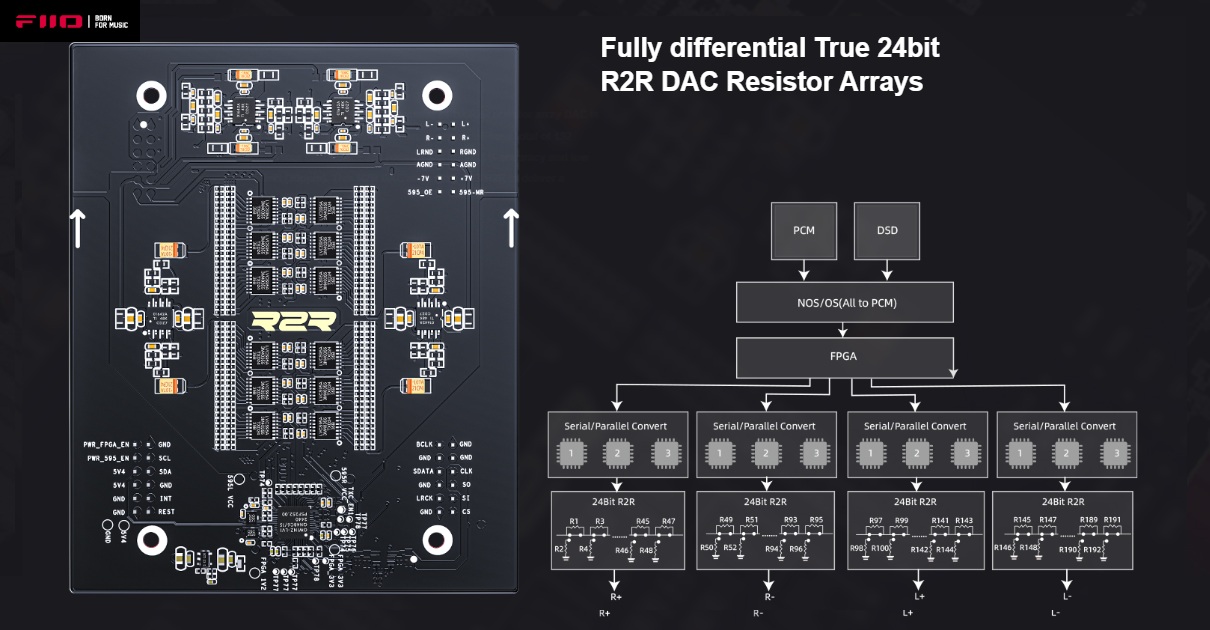
FiiO integrates operational flexibility by including hardware-switchable NOS (Non-Oversampling) and OS (Oversampling) modes. The NOS mode bypasses digital filtering, which typically results in a smoother, more fluid output. Conversely, the OS mode activates oversampling filters, which enhances technical performance metrics such as transient speed and micro-detail retrieval, yielding a sound that is focused and technically detailed.
The amplification stage of the K13 R2R is configured to drive demanding headphones. It utilizes dual OPA1642 op-amps in the Low-Pass Filter (LPF) stage and dual TPA6120A chips for the final headphone amplification. This setup allows the unit to achieve a balanced output of 2400 mW into a 32Ω load (4.4mm BAL). This high-current capability is essential for effectively driving both high-impedance headphones and current-hungry planar magnetic models. The high power ensures challenging headphones maintain control and dynamic response. However, I would wish that FiiO had included an XLR balanced output beside the 3.5mm SE and 4.4mm BAL.
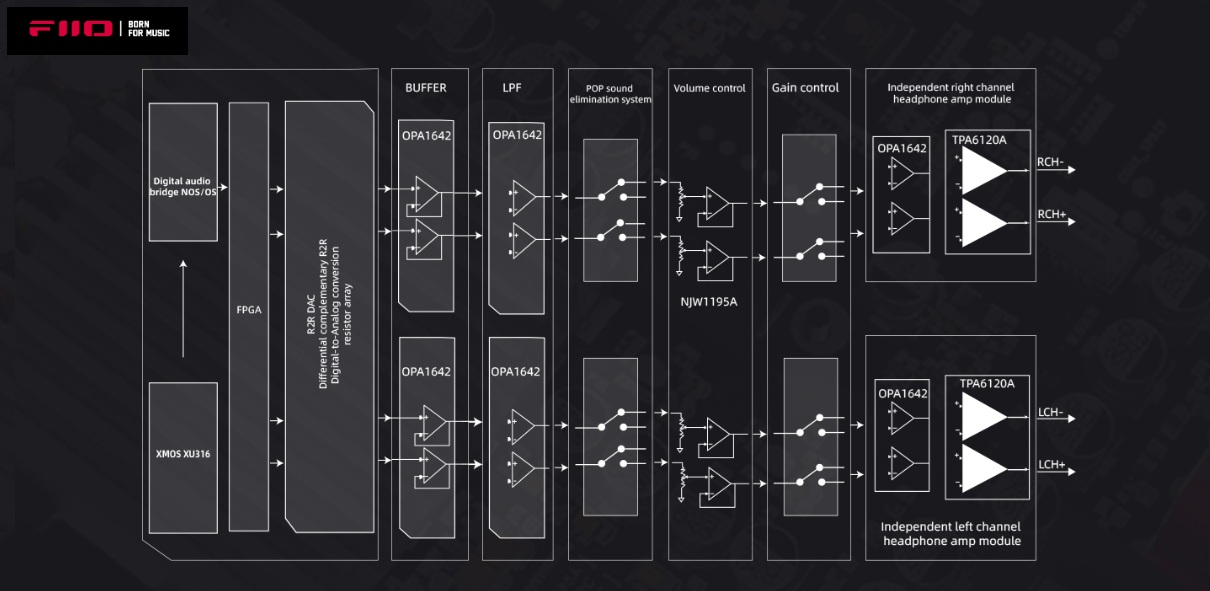
Digital hardware is controlled by the high-performance XMOS XU316 chip, which manages high-resolution digital streams. This controller supports contemporary formats, including PCM up to 384kHz 32bit and native DSD up to DSD256. Connectivity is further expanded by a built-in Bluetooth 5.4 module, which includes support for high-fidelity codecs such as LDAC.
A functional advantage in hardware configuration is the dual USB setup. The rear USB Input is typically used for a permanent PC connection, while the side USB Input is included for connecting portable devices (smartphones/DAPs) and is the designated port for Microcontroller Unit (MCU) firmware upgrades.
The K13 R2R offers flexible analog outputs for system integration, featuring a Balanced Line Output (XLR) and a Single-ended Line Output (RCA). Both outputs can be user-configured as either a fixed Line Out for separate amplifiers or a pre-amplifier output with variable volume control for powered monitors.
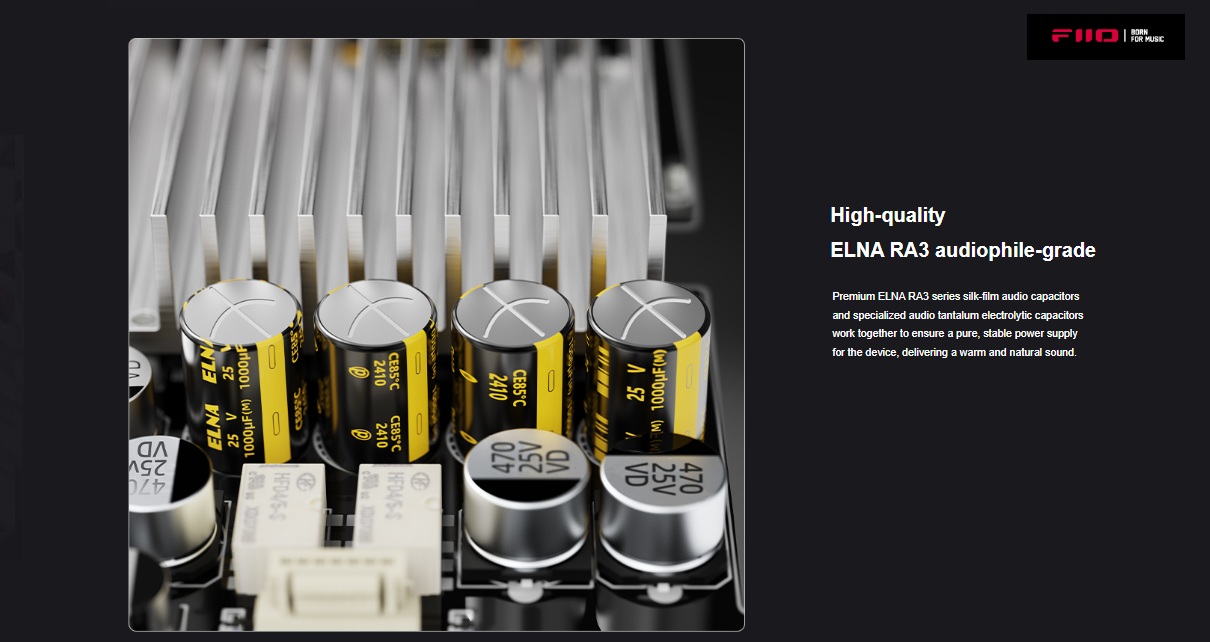
Finally, the unit’s power system provides flexibility: it includes an internal AC Power Input and an optional DC Power Input (12V) accessible via the AC/DC power switch, allowing for the use of an external linear power supply.
Software & Parametric EQ (PEQ):
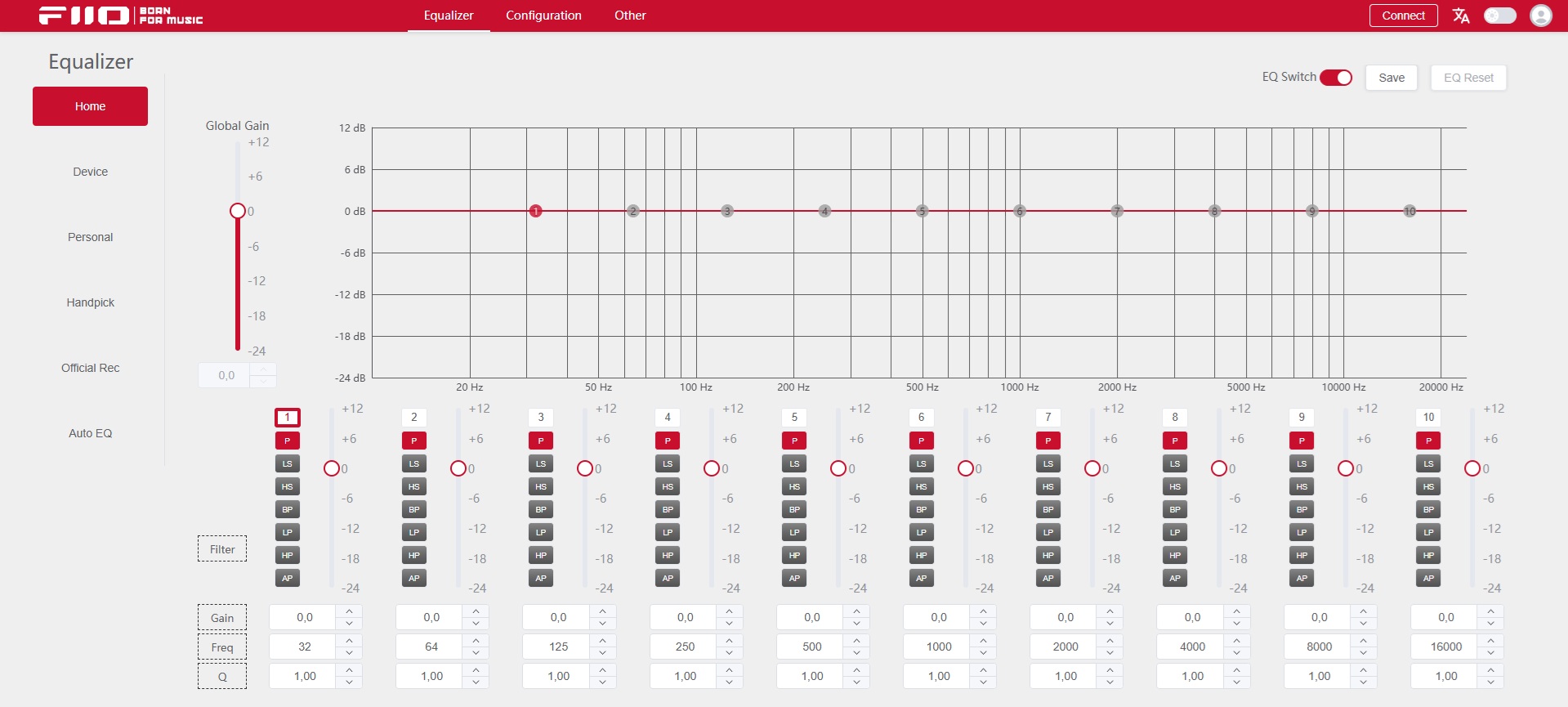
In addition to its internal hardware, the FiiO K13 R2R incorporates advanced digital signal processing (DSP) capabilities, which are controlled via its integrated software system. A core feature of this system is the 10-band Parametric Equalizer (PEQ).
Unlike standard graphic equalizers, the PEQ offers a comprehensive tool for precise sound tuning. It allows the user to adjust the center frequency, gain (boost/cut), and Q-factor (bandwidth) for each of the ten bands. This level of granular control is useful for correcting known frequency response deviations in coupled headphones or for adapting the sound signature to match personal preferences.
For instance, the PEQ can be utilized to implement a known target curve correction for the connected headphones, or to adjust sub-bass frequencies without compromising the clarity of the mid-range.
PEQ settings are managed using a dedicated companion application or a web-based interface, which provides a visual representation of the equalization curve. Importantly, once the desired PEQ profile is saved and activated on the K13 R2R, the processing is performed entirely by the on-device DSP hardware. This ensures that the customized sound signature is applied to all digital inputs (USB, Coaxial, Optical, and Bluetooth) without requiring continuous software intervention from the connected host device. This on-board DSP capability transforms the K13 R2R from a simple converter into an adaptable acoustic tool.
Equipment’s used for this review:
- DAC/Amplifier’s : FiiO K13 R2R, SMSL RAW-MDA1
- Sources : MSI Vector GP68 HX
- Headphones : FiiO FT5, HiFiMAN Sundara CB, MOONDROP Para
Albums & Tracks Used for this Review:
Vocal Jazz / Smooth Jazz
- Norah Jones – Come Away With Me (Flac 24bit/96kHz)
- Diana Krall – So Wonderful (DSF)
- Barry White – Just The Way You Are (Flac 24bit/48kHz)
- Isaac Hayes – Walk On By (Flac 16bit/44.1kHz)
- Sting – Englishman in New York (Flac 24bit/48kHz)
- Otto Liebert & Luna Negra – The River (Flac 24bit/192kHz)
- Ferit Odman – Look, Stop & Listen (Flac 24bit/192kHz)
- Charly Antolini – Duwadjuwandadu (Flac 24bit/192kHz)
Soul / R&B
- Aretha Franklin – I Say A Little Prayer (Flac 24bit/96kHz)
- Adele – My Little Love (Apple Lossless)
- George Michael – Don’t Let the Sun Go Down on Me (Flac 24bit/192kHz)
- Eric Clapton – Wonderful Tonight (Flac 24bit/96kHz)
Pop / Rock Classics
- Michael Jackson – Billie Jean (Flac 24bit/96kHz)
- Elton John – Rocket Man (Flac 24bit/96kHz)
- David Bowie – Heroes (Flac 24bit/192kHz)
- U2 – Sunday Bloody Sunday (Flac 16bit/44.1kHz)
- Lorde – Royals (Flac 24bit/48kHz)
- Dave Gahan – Kingdom (Apple Lossless)
Electronic / Experimental
- Daft Punk – Instant Crush (Flac 24bit/96kHz)
- Daft Punk – Doin’ it Right (Flac 24bit/96kHz)
- Bro Safari, UFO! – Drama (Apple Lossless)
- Armin Van Buuren – Vini Vici (Flac 16bit/44.1kHz)
- Yosi Horikawa – Bubbles (Apple Lossless)
- Toutant – Rebirth (Apple Lossless)
Alternative / Indie / Art Rock
- Radiohead – Live in Berlin “Album” (Apple Lossless)
- Radiohead – Pyramid Song (Apple Lossless)
- Muse – Hysteria (Flac 24bit/96kHz)
- Red Hot Chili Peppers – Nobody Weird Like Me (Flac 24bit/48kHz)
- Lunatic Soul – The Passage (Flac 16bit/44.1kHz)
- Portishead – It Could Be Sweet (Apple Lossless)
- Gogo Penguin – Raven (Flac 24bit/192kHz)
- Gogo Penguin – Murmuration (Flac 24bit/192kHz)
- Massive Attack – Angel (Flac 24bit/48kHz)
- Bear McCreary – Valkyries (Apple Lossless)
Classical / Orchestral
- Max Richter – On the Nature of Daylight (Flac 24bit/96kHz)
- Chopin – Nocturne No. 20 in C-Sharp Minor (Flac 16bit/44.1kHz)
- Clair de Lune – Claude Debussy (Apple Lossless)
- Tchaikovsky – Symphony No. 5 (Flac 16bit/44.1kHz)
- Vivaldi – Le Quattro Stagioni “The Four Seasons” (Apple Lossless)
- Fazıl Say – Nazım Oratoryosu (Live) (Flac 16bit/44.1kHz)
Jazz / Instrumental
- Miles Davis – So What (Apple Lossless)
World / Traditional
- Sertap Erener – Aşk (Flac 16bit/44.1kHz)
- Edith Piaf – Non Je Ne Regrette Rien (Flac 16bit/44.1kHz)
Metal / Progressive Rock
- Metallica – Dyers Eve (Flac 24bit/96kHz)
- Metallica – Sad but True (Flac 24bit/96kHz)
- Megadeth – Sweating Bullets (Apple Lossless)
- Opeth – Windowpane (Flac 16bit/44.1kHz)
- Deftones – My Own Summer (Shove It) (Flac 16bit/44.1kHz)
- Rush – Tom Sawyer (Flac 16bit/44.1kHz)
- Slayer – Angel of Death (Apple Lossless)
The Sound:
The FiiO K13 R2R delivers a signature sound that is highly musical, textured, and dynamically engaging, successfully blending the desirable analog character of its R2R core with the technical resolution expected of modern audio components. It successfully avoids the overly clinical or dry presentation often associated with entry level DACs, instead opting for a natural, grounded presentation while retaining excellent technical resolve. The overall sonic impression is heavily influenced by the user’s choice between the NOS and OS modes, offering a degree of sonic flexibility rarely found at this price point. This review was written after an approx. 85 – 90 hours of operational period, and the sound impressions are primarily based on the 4.4mm balanced output using the OS (Oversampling) mode, which was found to offer the optimal blend of the R2R’s inherent musicality with modern detail retrieval.
Bass:
The K13 R2R’s control over the low frequency spectrum is authoritative and reliable, a clear testament to its high power reserves and clean delivery. This capability is particularly evident when driving power hungry planar magnetic headphones. Paired with the FiiO FT5, the K13 R2R creates a synergy that results in outstanding control and texture in the sub and mid-bass. The FT5, which requires substantial current to achieve its full potential, is driven with such authority that its bass response is tight, impactful, and fast, maintaining a perfect separation between the sub frequencies and the midrange. The amplifier’s massive headroom allows the FT5’s large planar diaphragm to move freely and instantly, translating into a bass punch that feels both visceral and meticulously controlled. Compared to the HiFiMAN Sundara CB, the FT5 achieves a greater depth and textural resolution, directly benefiting from the K13 R2R’s clean 2400mW output. The sheer current reserve ensures that even complex, rapidly repeating bass lines are resolved without smearing or congestion. When engaging the NOS mode, the bass gains a subtle hint of warmth and body, contributing to a more organic, analog like saturation, but the OS mode provides the ultimate in planar control and bass definition with the FT5.
Midrange:
The midrange is perhaps the most compelling region of the K13 R2R’s presentation, exhibiting the hallmark organic texture and natural timbre associated with quality R2R implementations. The sound is richly saturated without ever becoming overly thick or veiled, maintaining a high degree of transparency. When utilizing the highly resolving FiiO FT5, the midrange of the K13 R2R allows vocals and acoustic instruments to shine through with exceptional clarity and a captivating natural body. The R2R architecture imbues the midrange with a subtle density and weight, giving vocals a substantial presence that is emotionally engaging and realistic. The superior micro dynamics are on full display, allowing subtle inflections in singing or the delicate resonance of a piano to be clearly perceived. The synergy ensures the FT5’s inherent neutrality is respected while benefiting from the R2R’s organic layering, which provides an excellent sense of depth within the midrange. The lower midrange is full bodied, lending weight and emotional depth, while the upper midrange avoids shoutiness, remaining smooth yet detailed. The NOS mode further accentuates this warmth, providing an even smoother, more intimate presentation, while the OS mode keeps the midrange transparent and even throughout, maximizing the FT5’s resolution capabilities and providing superior separation of voices and instruments.
Treble:
The treble from the FiiO K13 R2R strikes a fine balance between being extended and refined, ensuring that detail is delivered without leading to listener fatigue. This balance is critical, especially when driving high resolution planar drivers. The synergy with the FiiO FT5 in OS mode is excellent for achieving maximum detail retrieval and a realistic sense of ‘air’. High frequency percussion possesses a crisp attack and a natural, shimmering decay, adding an appreciable sense of airiness that contributes significantly to the perception of space within the soundstage. The resolution in the upper registers is notably fine and granular, allowing the listener to perceive the metallic texture of cymbals and high hats without the sound turning sharp or abrasive. The K13 R2R’s clean amplification prevents harshness or sibilance, even at higher volumes. Compared to the MOONDROP Para, which can sometimes appear slightly aggressive in the upper registers due to its low impedance and high sensitivity, the FT5 remains more composed and natural with the K13 R2R, benefiting from the amp’s tight voltage control. Engaging the NOS mode slightly rounds off the initial transient attack of the treble, offering a silkier and more forgiving high end, which can be ideal for bright masterings. The K13 R2R maintains control and avoids smoothing out details excessively, presenting the high frequencies as they were in the track. The resultant treble is detailed and crisp enough to resolve textures, yet smooth enough to be deeply engaging and comfortable over extended periods.
Soundstage & Imaging:
The K13 R2R’s technical proficiency is evident in its spatial presentation, which, considering its price point, benefits significantly from the R2R DAC’s low noise floor and the amplifier’s control. The resulting soundstage is wide, deep, and presents a convincing sense of three-dimensional space, accurately reflecting the recording’s spatial information. Instrument placement (imaging) is rendered with high accuracy and clear depth, allowing for precise localization of individual sound elements. Sound separation is excellent, maintaining distinct layering that prevents congestion, even during complex passages. The strong, clean amplification ensures that connected drivers maintain firm control, supporting sharp, confident imaging and a well-organized sound picture. This spaciousness and precision prioritize the integrity of the recording, providing a detailed listening environment without spatial exaggerations.
Comparison:
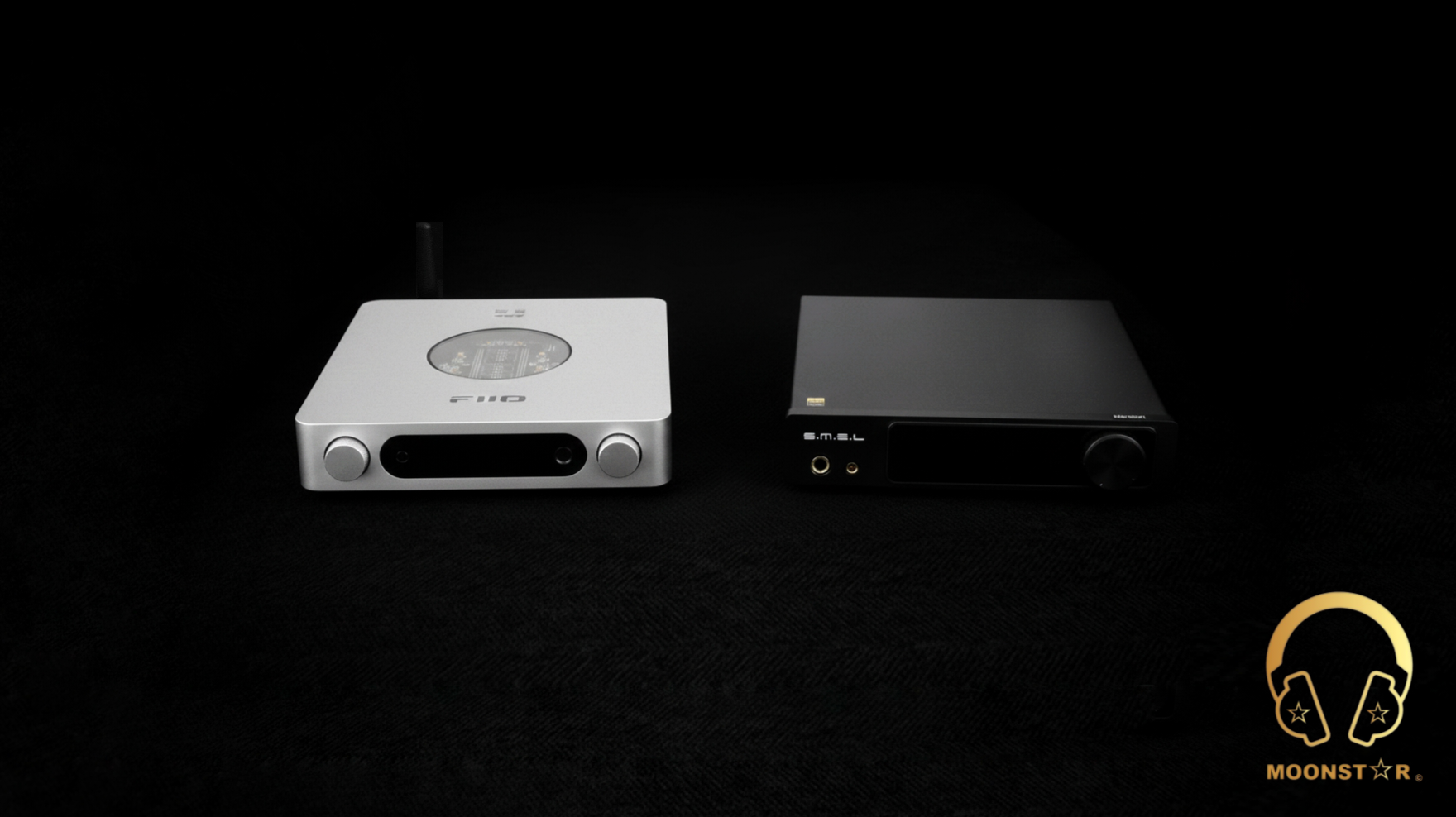
FiiO K13 R2R versus SMSL RAW-MDA1:
The FiiO K13 R2R and the SMSL RAW-MDA1 are two popular mid-market desktop audio solutions that appeal to distinct listener preferences. The K13 R2R utilizes an R2R ladder architecture emphasizing musical texture and dynamic authority, providing an engaging sound, while the RAW-MDA1 offers a strictly neutral and highly controlled output ideal for those who prioritize transparency above all else. Both units deliver excellent performance for their price bracket, but the K13 R2R holds critical advantages in power delivery and sonic weight.
The most significant performance distinction lies in power reserve and low-frequency handling. The FiiO K13 R2R possesses a commanding edge with its substantial 2400mW balanced output, making it undeniably superior for efficiently driving high-impedance and particularly demanding planar magnetic headphones. This immense power translates directly into a low-end performance defined by authoritative dynamic punch and superior grip, ensuring solid control even under strain. The SMSL RAW-MDA1, conversely, provides a highly precise and articulate low-end that is excellent for accuracy, but its power delivery simply cannot replicate the dynamic force and effortless headroom that the K13 R2R provides when faced with truly current-hungry drivers.
Moving into the Midrange and Treble, the K13 R2R’s R2R core imparts a distinctive sonic signature, adding a desirable organic density and natural texture to the midrange. This results in vocals and acoustic instruments having a more palpable weight, lending the presentation a touch of musical richness. The SMSL RAW-MDA1 stands firm in its design philosophy, delivering pristine clarity and uncolored smoothness. Its midrange is superb for technical transparency; however, this dedication to clinical accuracy means it inherently avoids the harmonic richness and sonic weight that makes the K13 R2R’s sound immediately more “textured” and emotionally appealing. In the treble, the RAW-MDA1 excels at control and fatigue-free extension, while the K13 R2R offers a slightly more crisp and dynamically layered presentation.
Finally, regarding Soundstage and Imaging, the K13 R2R often provides a more expansive and dynamically holographic spatial experience, benefiting from the clean power that allows drivers to move freely and quickly. This results in sharp, confident imaging across a wide field. The SMSL RAW-MDA1 provides an accurate and well-defined soundstage, consistent with a reference-level device; yet, for sheer volume and three-dimensional layering, the K13 R2R’s robust presentation typically offers a more immersive experience. Given its superior power reserves and the engaging, textured nature of the R2R sound, the FiiO K13 R2R is arguably the more potent and versatile choice for an enthusiast seeking to maximize performance across a diverse and demanding headphone collection in this price segment.
Conclusion:
The FiiO K13 R2R provides a cohesive and strong performance solution within the competitive midrange desktop DAC/Amp segment. The foundation of its 24-bit R2R architecture delivers a sound characterized by musical texture and natural tone, distinguishing it from conventional alternatives in its price class. This DAC section is coupled with a highly capable amplifier, offering 2400mW of clean, controlled power that efficiently drives demanding high-impedance and current-hungry planar magnetic headphones. The K13 R2R’s feature set is comprehensive, including switchable NOS/OS modes, a customizable 10-band PEQ, extensive connectivity options with XLR balanced out, and Bluetooth 5.4 (LDAC) support. These features establish the unit as a flexible, all-in-one desktop audio hub. The K13 R2R is a mature device that effectively blends a unique R2R sonic character with modern utility, making it a reliable recommendation for enthusiasts seeking a versatile desktop audio component at an accessible price point.
Pros & Cons:
- + Natural, textured, and smooth sonic signature
- + Substantial 2400mW output (32 ohm balanced load)
- + 10-band Parametric Equalizer
- + Comprehensive I/O (XLR balanced out, dual USB, Coaxial, Optical)
- + High resolution Bluetooth 5.4 (LDAC support)
- + Switchable NOS/OS modes
- + Top-mounted viewing window showing the R2R resistor
- + Functions as an all-in-one desktop hub
- + Accessible price point for R2R technology and features
- – Would wish that FiiO had included an XLR balanced headphone output
Thank you for the Read!