TimeEar BTE-9 Review
TimeEar BTE-9 Review
Introduction:
TimeEar is a relatively new Chinese audio brand focusing on affordable portable Hi-Fi solutions, particularly compact DAC/amplifiers that offer solid performance for the price. The company has begun attracting attention from budget-conscious enthusiasts with practical designs, reliable build quality, and useful everyday features. The BTE-9 under review is the brand’s flagship ultra-portable Bluetooth and USB DAC/amplifier, designed as a versatile all-in-one device compatible with Android, iOS, Windows, and macOS. It features a premium Cirrus Logic CS43198 DAC chip, dual ESS Sabre ES9603 OPAMP-based amplifiers, and Qualcomm’s QCC5125 Bluetooth processor. The unit offers both 3.5mm single-ended and 4.4mm balanced analog outputs, while supporting high-resolution wireless codecs for lossless audio streaming. It is available in three elegant color options: Titanium Gray, Navy Blue, and Pearl White.
In this review, we will examine its design, build quality, technical capabilities, connectivity performance, battery endurance, and sound signature across various transducers, including detailed frequency response analysis and direct comparisons with competing models.

Disclaimer:
I would like to thank TimeEar for providing me the BTE-9 sample for review purposes. I am not affiliated with TimeEar beyond this review and these words reflect my true and unaltered opinions about the product.
Price & Availability:
The TimeEar BTE-9 is priced at approximately 79.00 USD for the standalone unit. A protective silicone case is available as an optional bundle: regular price $79.90 without the case, $84.90 when bundled together. The case can also be purchased separately later for a regular price of $9.90. More information’s can be found under the link below;
Package & Accessories:
The device arrives in a minimalist black box featuring the product image and key feature icons on the front.

Inside the package you will find:
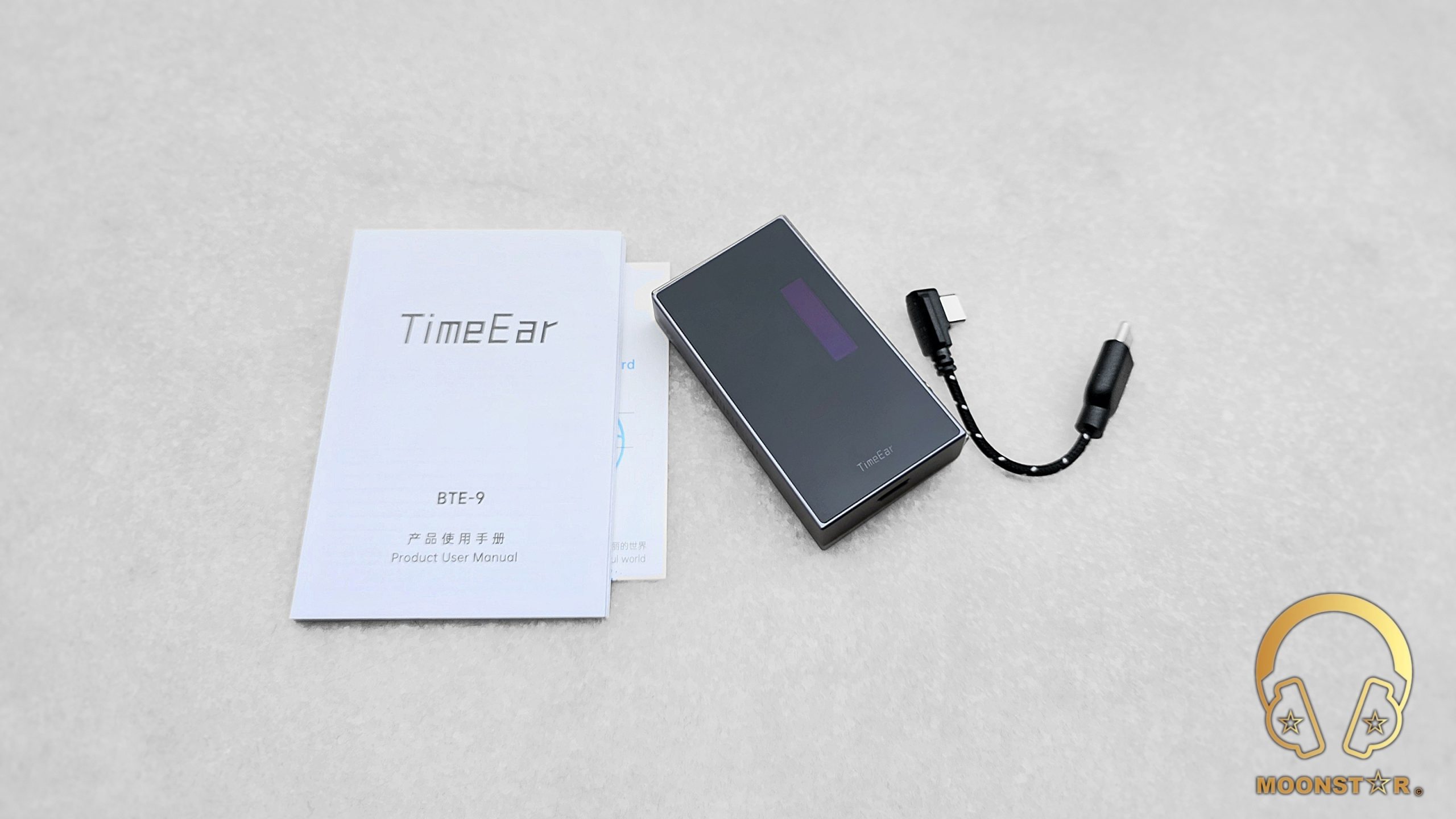
- 1 x TimeEar BTE-9 Portable Bluetooth & USB DAC/Amplifier
- 1 x TEC-B1 patented ultra-thin L-shaped USB Type-C audio cable
- 1 x Quick start guide and warranty information

Design & Build Quality:
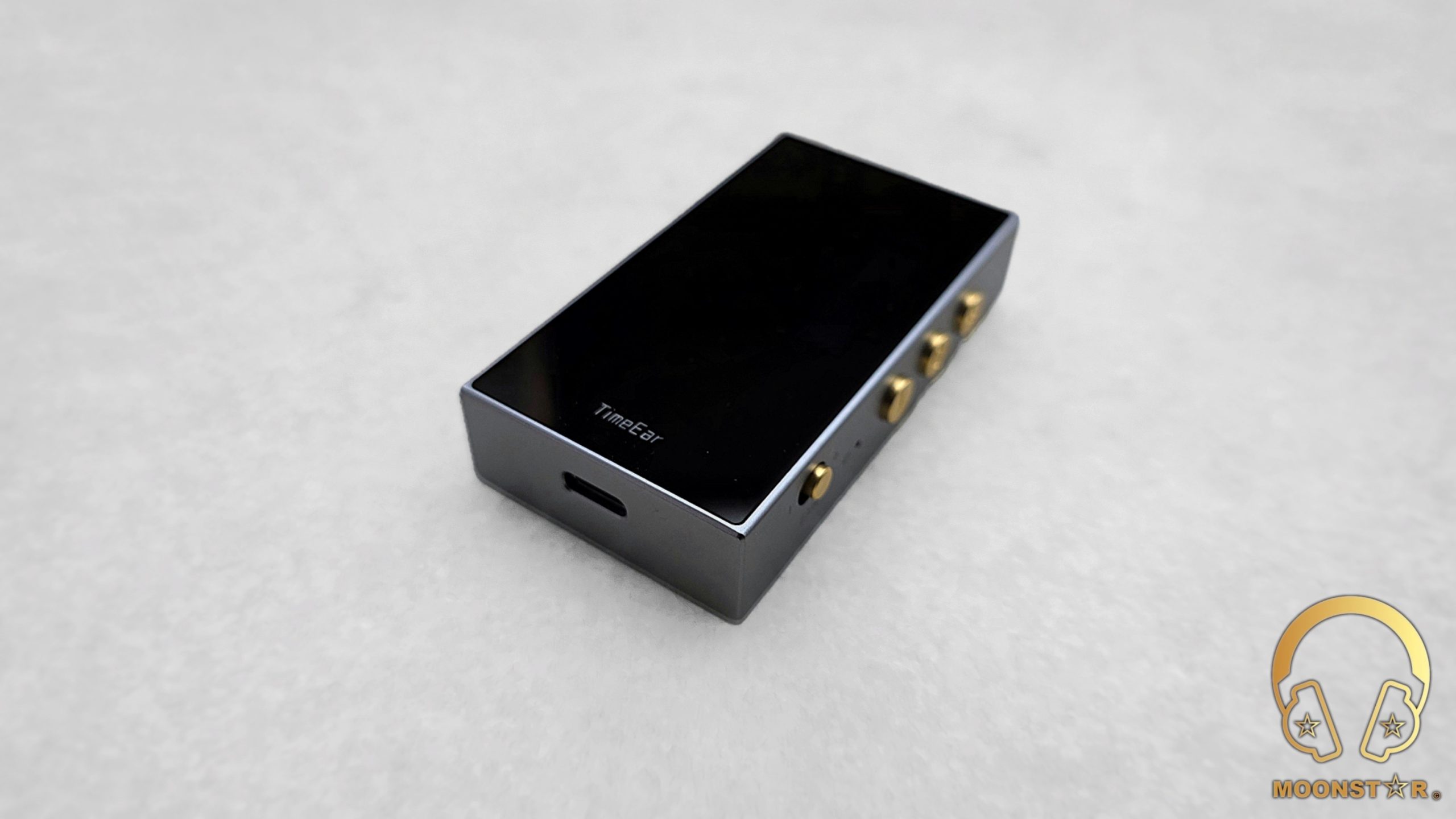
The BTE-9 combines wireless Bluetooth functionality with wired USB DAC performance in a remarkably compact form factor, constructed from precision-machined CNC aluminum forming a unibody chassis with a front tempered glass panel. The metal frame wraps seamlessly around the edges, providing structural rigidity and a premium in-hand feel.

The front surface is covered in smooth black tempered glass, while the rear and sides are part of the single-piece aluminum body.

The device is available in Titanium Gray, Navy Blue, or Pearl White finishes, each offering a distinct aesthetic while maintaining a fingerprint-resistant coating that holds up well during daily use.

With dimensions of 70 mm x 39 mm x 15 mm and weighing around 65 grams, the BTE-9 is genuinely pocket-sized yet feels substantial. The balance between metal and glass contributes to durability and elevates the visual appeal to a level typically seen in higher-priced competitors.

On the front face sits a Monocrome OLED screen with a resolution of 128×64 pixels.

Below the screen, at the bottom of the front panel, is the TimeEar logo with an integrated LED indicator beneath it that provides real-time information such as connection status, and active codec.

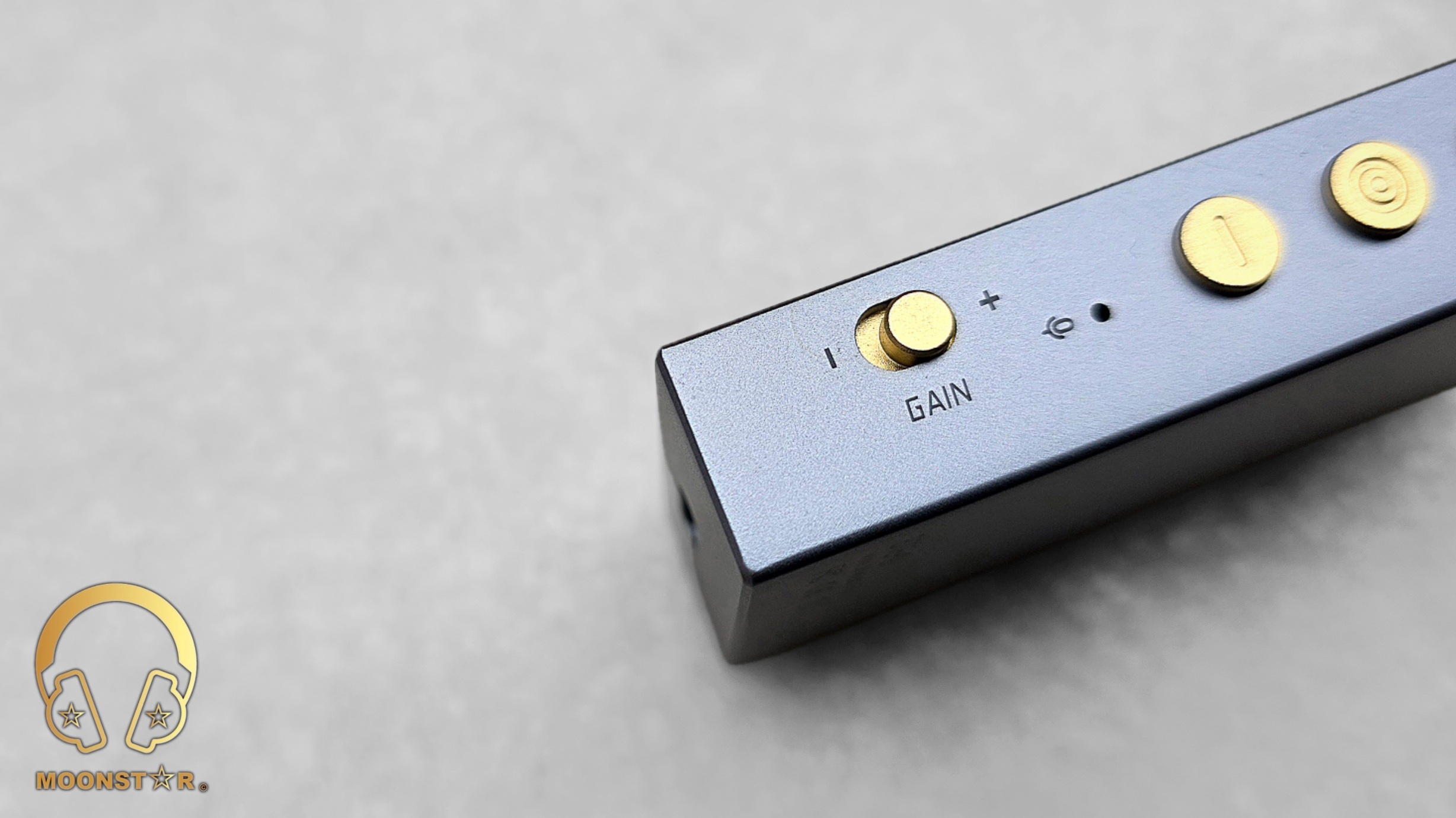
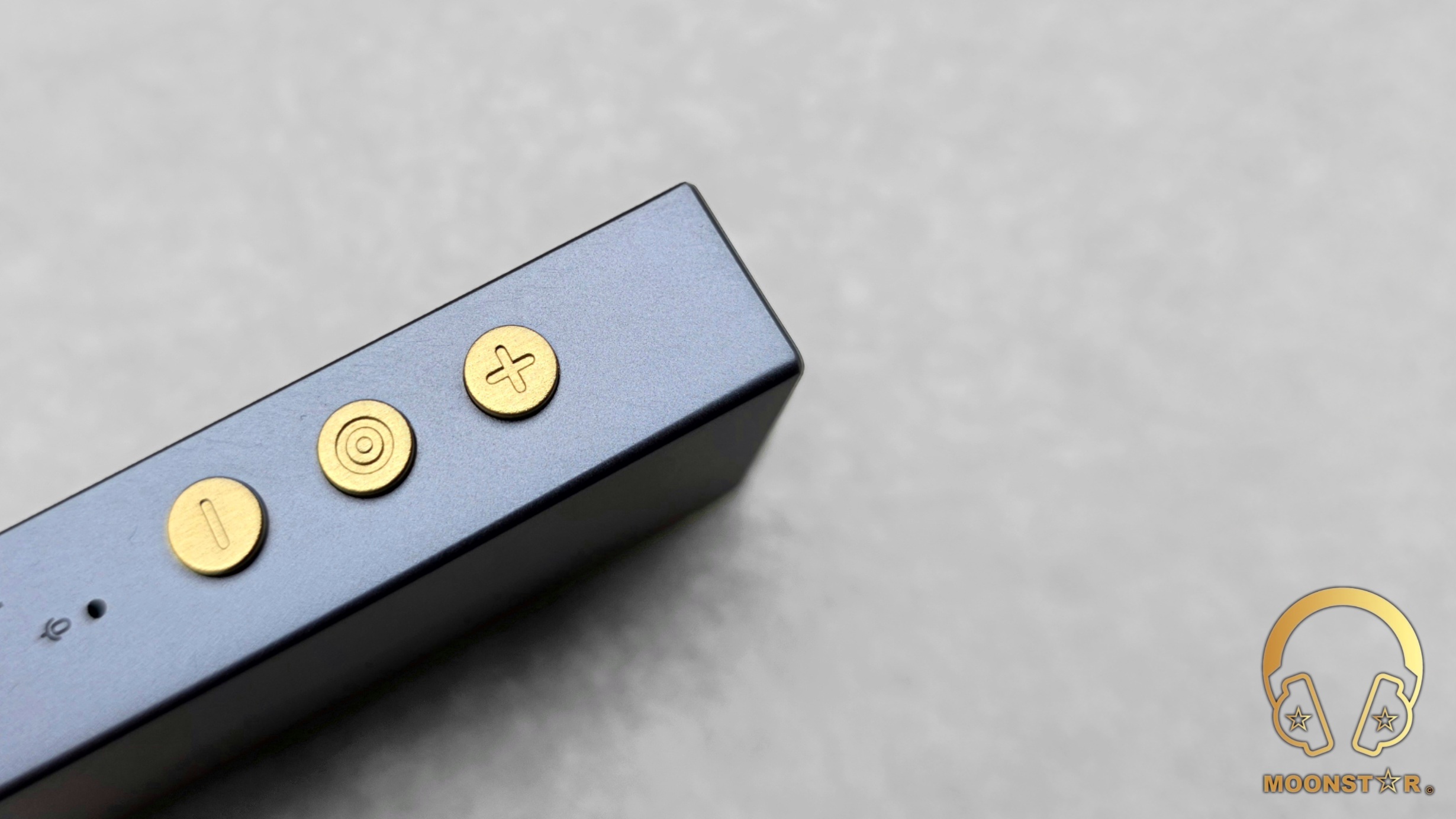
The right edge houses gold-colored controls: a low/high gain switch, a microphone grille, volume up/down keys that double as next/previouse track buttons.

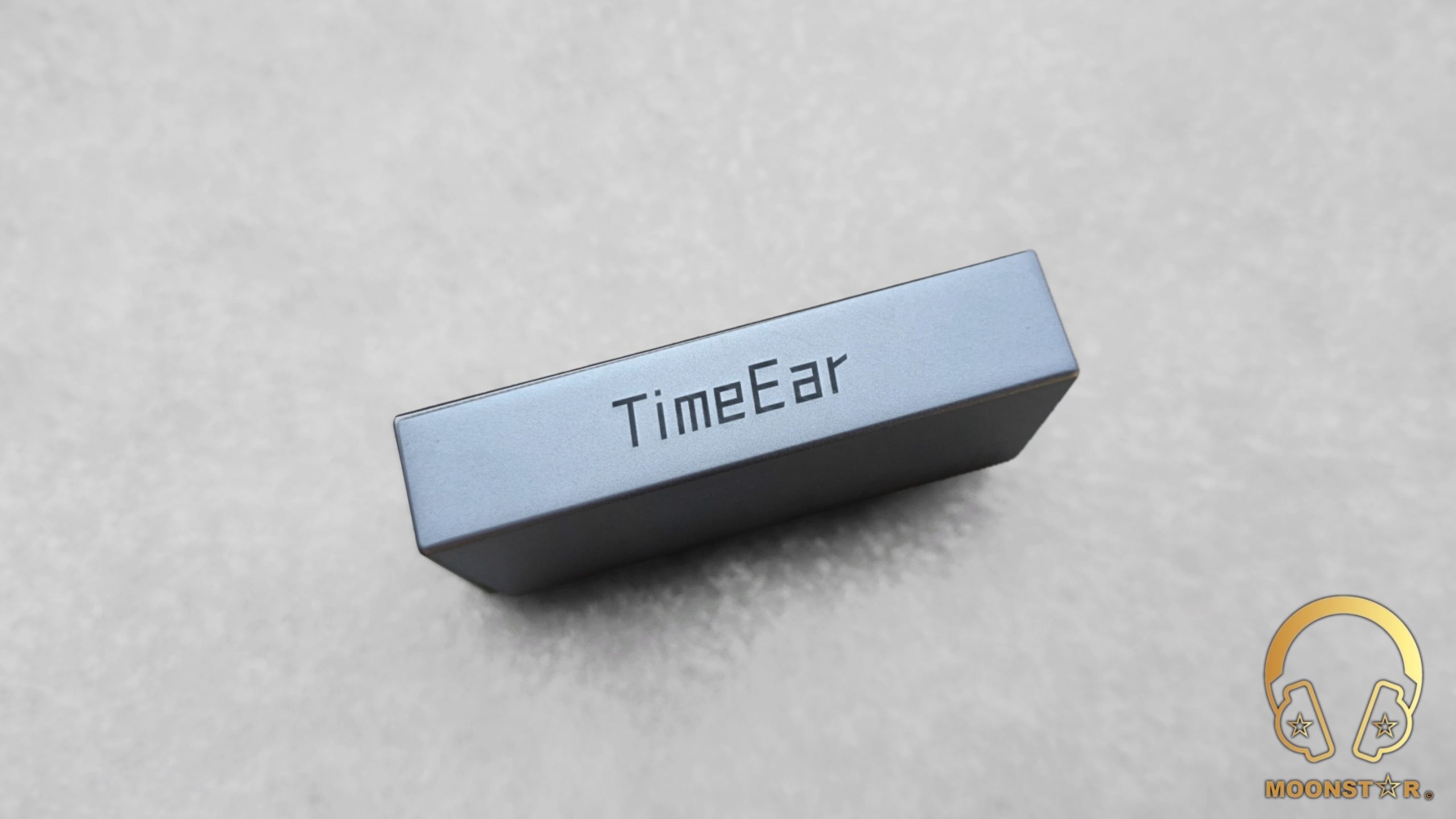
The left edge features the TimeEar branding.
The top surface contains the gold-plated 3.5mm single-ended and 4.4mm balanced output jacks, both securely mounted with no wobble. However, the 4.4mm balanced jack is notably tight, requiring firm insertion for secure connection, which is the only minor design critique. Centered precisely between the two outputs is the second microphone, serving as an ambient sound pickup microphone.

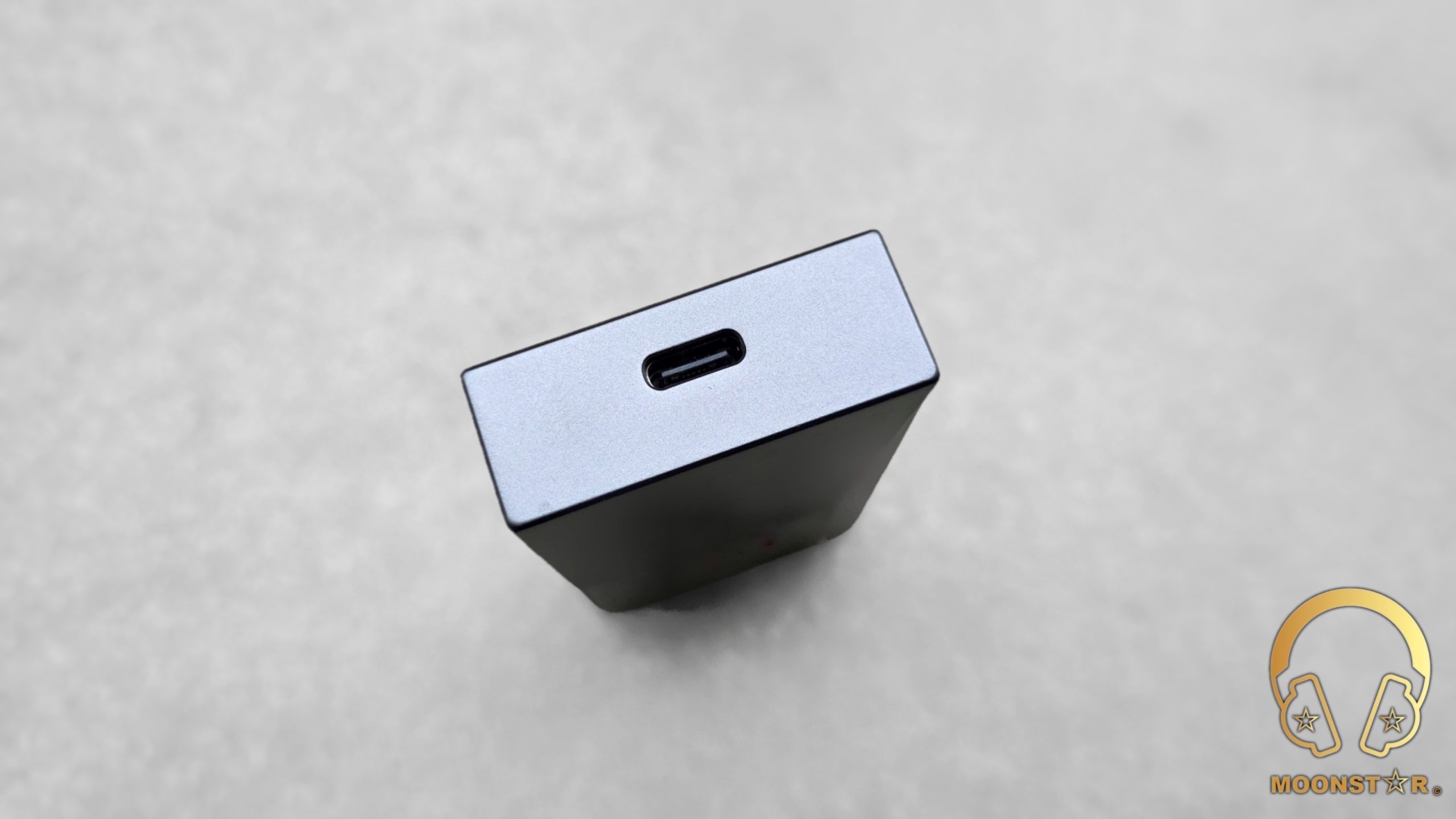
The bottom surface contains the USB Type-C port, which handles both charging and digital audio input.
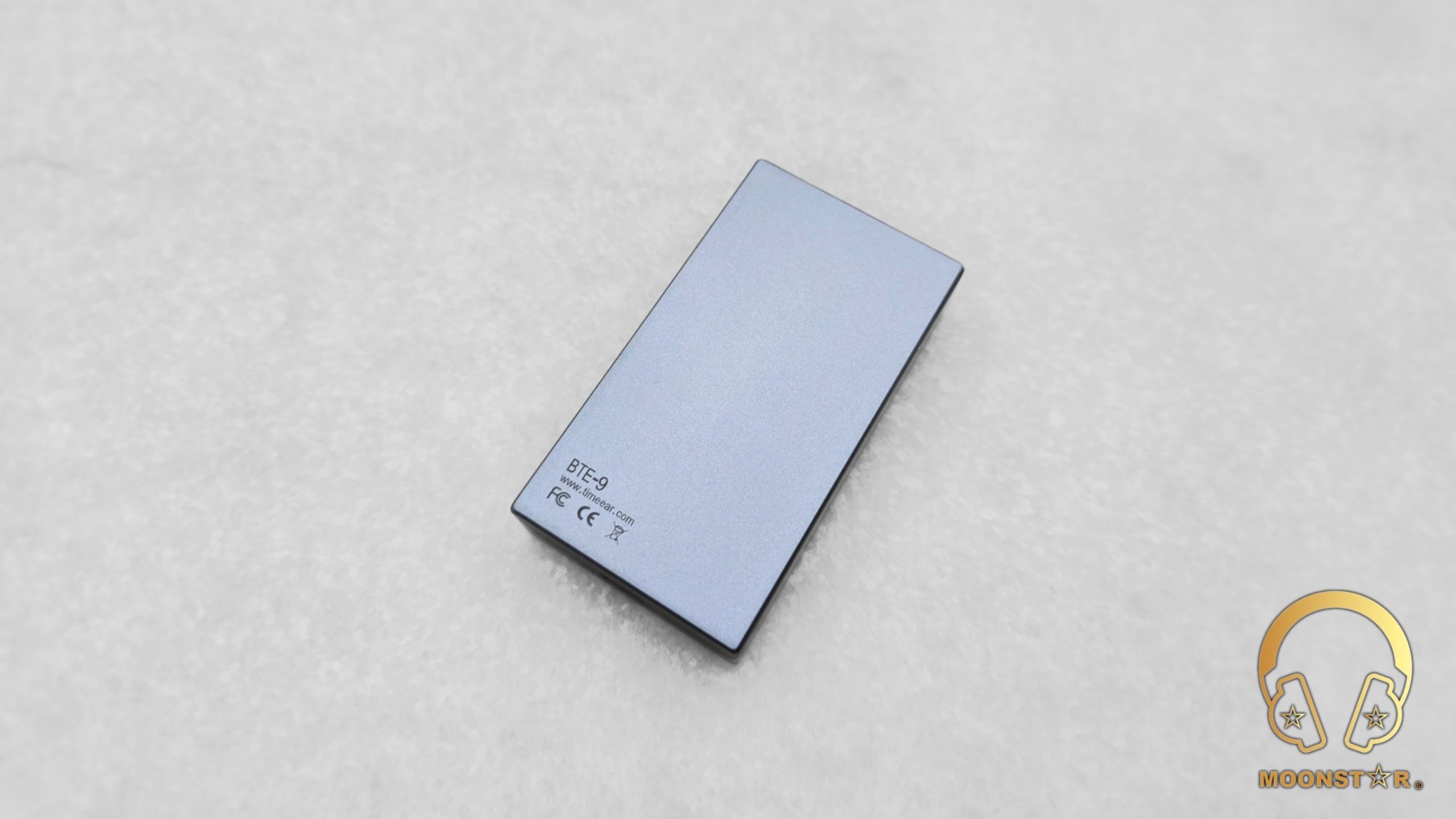
The rear panel is plain aluminum, with only a small area in the lower right corner dedicated to BTE-9 branding, the official website link, and industrial certification markings.
 Overall build quality is exceptional, solid, refined, and confidently assembled, easily rivaling devices at twice the price.

Technical Specifications:
- Model: BTE-9
- DAC Chip: Cirrus Logic CS43198
- Amplifier: Dual ESS Sabre ES9603 OPAMP
- USB Interface: UAC 2.0
- Sampling Rates: Up to 32bit/768kHz and DSD256 (chip capability), limited to 48kHz in standard USB DAC mode
- Bluetooth Chip: Qualcomm QCC5125
- Bluetooth Version: 5.1
- Bluetooth Codecs: LDAC, aptX HD, aptX LL, aptX Adaptive, AAC, SBC
- Operating Range: 10 to 12 meters (line of sight)
- Output Power: 3.5 mm SE 100 mW @ 32 Ω / 4.4 mm BAL 240 mW @ 32 Ω
- SNR: 4.4 mm BAL 116.8 dB / 3.5 mm SE 117 dB
- THD+N: 4.4 mm BAL 0.022% / 3.5 mm SE 0.0068%
- Battery Capacity: 1000 mAh
- Playback Duration: Up to 20 hours (SBC), ~18.5 hours (LDAC)
- Charging Time: 1.5 to 2 hours
- Dimensions: 70 mm x 39 mm x 15 mm
- Weight: ~65 grams
- Color Options: Titanium Gray, Navy Blue, Pearl White
Hardware & Connectivity:
The BTE-9 is engineered to serve as a complete portable audio hub, supporting a wide range of devices and use cases, from smartphones and tablets to laptops. Connection reliability is among the best in its class. It features a full-function USB-C mode, supporting USB-Audio for use as a “dongle” or sound card. It can also activate the dual microphones for USB-Voice to provide audio input for devices. Note that the USB mode requires the BTE-9 to be powered on before connecting to audio output devices.

DAC / Outputs / Power / Background Noise:
The Cirrus Logic CS43198 is a high-performance DAC known for its low noise floor, wide dynamic range, and accurate signal reproduction. The chip itself supports sampling rates up to 768 kHz and native DSD256 playback. However, when the BTE-9 operates in standard USB DAC mode on most platforms, it is limited to 48 kHz output due to current firmware constraints. This restriction does not affect Bluetooth performance or third-party app playback on Android, where higher rates remain accessible.
A future software update may unlock the full potential of the DAC in wired mode. Even at 48 kHz, distortion remains vanishingly low across the audible spectrum, and channel separation is excellent. When tested with high-resolution sources via dedicated players like USB Audio Player PRO, the output is transparent, detailed, and free from digital artifacts. No resampling or jitter issues were observed across Windows, macOS, or Android platforms in supported modes.
The BTE-9 offers 3.5mm stereo output and 4.4mm balanced output interfaces, with both ES9603 chips participating in the output, delivering excellent output specifications. The 4.4mm balanced output achieves a signal-to-noise ratio of 116.8dB and a distortion rate as low as 0.022%; the 3.5mm stereo output boasts a signal-to-noise ratio of 117dB and a distortion rate as low as 0.0068%.

It features a fully balanced internal architecture, with independent DAC and amplifier paths for left and right channels powered by dual ESS Sabre ES9603 OPAMPs. The 4.4mm balanced output delivers up to 240 mW into 32 ohms, more than enough to drive demanding planar magnetic headphones or high-impedance dynamic models without strain. The 3.5mm single-ended output provides 100 mW, perfectly suited for sensitive IEMs.
The BTE-9 offers low-gain and high-gain modes, compatible with headphones of different impedances and sensitivities. After Bluetooth connection, the volume adjustments of the Bluetooth transmitter and the BTE-9 are independent of each other. The 63-level volume control inside the BTE-9 enables extremely precise volume adjustment. Background noise is effectively nonexistent; even with ultra-sensitive armature-based IEMs, the noise floor remains pitch black at all volume levels and gain settings.

Bluetooth & Pairing:
Powered by the Qualcomm QCC5125 SoC and Bluetooth 5.1, the BTE-9 maintains rock-solid wireless performance. LDAC at 96 kHz/24-bit operates without dropouts, even through walls or at distances exceeding 10 meters. In real-world testing, the connection remained stable up to 11.5 meters in open spaces with direct line of sight, dropping gracefully to 9 meters indoors through two drywall partitions while maintaining full LDAC bitrate. Beyond 12 meters, occasional micro-stutters appeared in high-interference environments, but reconnecting was instantaneous. Low-latency codecs such as aptX LL and aptX Adaptive ensure perfect lip-sync during video playback on YouTube, Netflix, or Disney+, with no perceptible delay even during fast-paced action scenes.
Multi-point connectivity allows seamless switching between two devices, ideal for jumping between phone and laptop, with transitions taking less than two seconds. NFC one-tap pairing works instantly with compatible Android phones, eliminating manual setup. Overall range, stability, and codec support place it at the top of its segment.
USB DAC Mode:
When connected via USB, the BTE-9 functions as a proper asynchronous DAC with UAC 2.0 compliance. It is plug-and-play across major operating systems, no drivers required. In standard system audio paths, output is capped at 48 kHz/16-bit, though third-party applications on Android can bypass this for higher resolutions. Sound quality in USB mode is clean, neutral, and powerful, with ample headroom and precise imaging. It easily outperforms built-in laptop audio and rivals dedicated desktop DACs in clarity and control within the supported sample rates.
Microphone:
Dual beamforming microphones with Qualcomm cVc 8.0 noise suppression deliver clear, intelligible voice pickup. Background noise from traffic, wind, or office chatter is significantly reduced. Call recipients report natural timbre and good volume, with no metallic or muffled quality. Performance surpasses most Bluetooth audio devices in this price range and holds its own against dedicated headset mics.
Battery Performance:
The integrated 1000 mAh battery provides exceptional runtime, which proved particularly impressive during extended testing. In balanced output with LDAC enabled and volume at 60/100, playback exceeds 18 hours consistently across multiple sessions, dropping to around 17 hours during intensive high-volume use with demanding loads like the SIVGA Peng over-ear headphones. Switching to SBC extends this beyond 20 hours, often hitting 21 to 22 hours in lighter scenarios such as casual commuting or office work with efficient IEMs. Real-world mixed usage, alternating between LDAC streaming and short USB DAC sessions, averaged 19 hours over a full day of intermittent listening. Standby drain is minimal, several days with Bluetooth active, and up to 800 hours claimed in full idle mode, which aligns well with real-world tests where it held charge for over a week without use.
Charging via USB Type-C at 5V/1A completes in under two hours, with the OLED showing a relative precise percentage increments every 10 to 15 minutes. For daily commuters or long flights, a single charge easily lasts a full week of moderate use, making it one of the most reliable in its class for extended outings.
Companion App:
The TimeEar official app, currently available only for Android, enables online firmware upgrades and custom EQ adjustments for the BTE series, with changes taking effect immediately. It supports switching between custom EQ profiles and default bypass mode, as well as saving multiple EQ files locally or in the cloud. Users can share custom EQs via WeChat and import them from others. The interface is clean and responsive, providing practical tools for basic tuning.
However, it falls short of more advanced counterparts like HiBy Link or FiiO Control in functionality, lacking parametric EQ support and deeper system integration. When using EQ, disabling the phone’s “Absolute Volume” Bluetooth setting prevents potential popping. For most users, the onboard controls and OLED display suffice for daily operation, but those seeking fine-grained tuning may rely on source-side adjustments.

Equipment’s used for this review:
- DAC/Amplifier’s : TimeEar BTE-9, iFi GO Blu,IKKO Heimdallr ITB03
- IEM’s/Headphones : Oriveti Bleqk Purecaster, ZiiGaat Horizon, SIVGA Peng
- Sources : Samsung Galaxy S25 Ultra, MSI Vector GP68 HX 13V
Albums & tracks used for this review:
- Jazz: Diana Krall – “So Wonderful,” Norah Jones – “Come Away With Me”
- Pop: Adele – “My Little Love,” Lorde – “Royals,” Billie Eilish – “Bad Guy”
- Classical: Vivaldi – “The Four Seasons,” Chopin – “Nocturne No. 20”
- Rock: Muse – “The Handler,” U2 – “Sunday Bloody Sunday,” Nirvana – “Come As You Are”
- Electronic: Daft Punk – “Doin’ it Right,” Massive Attack – “Angel,” Yosi Horikawa – “Bubbles”
- Metal: Metallica – “Sad but True,” Slayer – “Angel of Death,” Megadeth – “Symphony of Destruction”
- World: Otto Liebert – “The River”
The Sound:
The BTE-9 delivers a neutral-leaning signature with a mild, tasteful coloration most noticeable in the lower frequencies and subtly in the upper ranges. This gentle tuning adds a touch of warmth and engagement without veering into exaggeration. It enhances musicality while preserving clarity and detail, proving particularly enjoyable across the tested transducers. All impressions are based on the 4.4mm balanced output after a 60-hour burn-in period, using the equipment listed above.
Bass:
Low frequencies are tight, textured, and extended with impressive authority, enriched by a subtle warmth that lends extra body and impact without dominating the mix. Subbass reaches deep into the infrasonic range, delivering weight that vibrates subtly through the drivers of the Oriveti Bleqk Purecaster. This adds a tactile, satisfying layer that enhances immersion without unwanted resonance or overhang.
The response remains relative linear yet impactful, with good sense of decay that allows each note to settle naturally. It keeps dense mixes articulate and uncolored. Midbass punch is articulate and fast, now carrying a pleasing fullness that conveys the physicality of kick drums or bass guitar lines with added heft. Paired with the ZiiGaat Horizon’s tribrid setup, this region gains layered depth. The dynamic driver integrates seamlessly with the BTE-9’s amplification, producing strikes that feel rounded, full-bodied, and musically engaging. They never become bloated or smeared. With the SIVGA Peng over-ear headphones, the BTE-9’s dual ESS Sabre ES9603 OPAMPs supply ample current for controlled, visceral slams that retain texture and speed.
The mild coloration here adds a natural richness that elevates the Peng’s analog character without sluggishness. Transitions from subbass to midbass are smooth, with no bleed into the lower mids. This maintains clarity in rapid sequences. The amplification scales power effectively across gain settings. It handles the Peng’s impedance curve effortlessly while tempering any softness in the Purecaster and Horizon. This delivers controlled aggression that suits both acoustic warmth and electronic drive. Overall, the bass strikes a confident, enjoyable balance. Depth and dynamics reward critical listening, while the subtle coloration makes long sessions particularly pleasurable.

Midrange:
Vocals and acoustic instruments are presented with remarkable clarity, body, and emotional weight. The lower midrange has just enough fullness to ground male vocals and cello lines without thickness. It provides a natural warmth that conveys timbre accurately. The subtle chest resonance in deeper registers emerges with realistic density when driving the Oriveti Bleqk Purecaster. The single dynamic driver’s efficiency allows the BTE-9 to highlight harmonic overtones without veiling or forwardness.
Upper mids transition smoothly, avoiding shoutiness or harshness even at elevated volumes. A transparency reveals breath control and phrasing in vocal performances. The ZiiGaat Horizon benefits immensely here. Its balanced armatures receive clean amplification that preserves neutrality while subtly enhancing texture. This ensures guitars and pianos retain woody richness and string attack without etch or recession. The SIVGA Peng, with its large dynamic driver and open-back design, presents a broader midrange canvas. The BTE-9 fills it with authoritative yet refined energy. Piano chords ring with natural sustain and decay. Acoustic guitar plucks carry realistic body and air, free from compression.
Micro-dynamics in quiet passages, such as finger slides on guitar strings or the gentle swell of a piano sustain, are rendered with finesse. This showcases the low noise floor and dynamic range that capture whispers and crescendos with equal poise. Instrument separation is exemplary. Violas and acoustic bass hold distinct spatial cues in ensembles. The overall tonality leans toward organic, engaging reproduction. Paired with these transducers, the midrange avoids digital sterility. It offers a cohesive, emotionally resonant flow across genres from intimate jazz to orchestral works that feels musically satisfying.

Treble:
High frequencies extend effortlessly with air, sparkle, and control. They are elevated by a subtle upper-range refinement that adds smoothness and polish without fatigue or artificial brightness. The lower treble provides definition and presence to percussion and string harmonics. A gentle lift adds liveliness to hi-hats and snare edges. Through the Oriveti Bleqk Purecaster’s interchangeable nozzles, this manifests as refined detail retrieval. The balanced option yields smooth, even-handed extension that complements the BTE-9’s tuning. It ensures cymbals decay with metallic realism rather than sizzle.
Upper treble airiness enhances spatial cues. This brings a holographic quality to orchestral highs or electronic transients. The ZiiGaat Horizon’s planar drivers shine under this amplification. The clean output results in crisp yet non-aggressive sparkle that reveals air around violin bows or reverb tails in ambient recordings. With the SIVGA Peng, the treble gains an expansive, ethereal quality. This renders violin harmonics and cymbal washes with natural brilliance and decay. It avoids congestion or roll-off. The presentation smooths potential digital glare while preserving micro-details like tape hiss or plucked harmonics. The refined energy ensures long sessions remain comfortable even with brighter masterings. Transitions from upper mids to treble are seamless, with no harsh sibilance. The extension feels boundless yet grounded. It prioritizes musical flow with an enjoyable, fatigue-free polish.

Soundstage & Imaging:
The presentation is wide, deep, and well-organized. Instruments occupy distinct positions with stable phantom center imaging. Layered productions unfold across a broad horizontal plane, with clear front-to-back depth. Height is moderate but sufficient for orchestral works. Separation and layering are excellent. Busy mixes never collapse into congestion. The balanced output enhances channel crosstalk performance. This results in a fairly holographic, out-of-head experience that rivals similar but pricier solutions
Comparisons:
TimeEar BTE-9 versus IKKO Heimdallr ITB03:
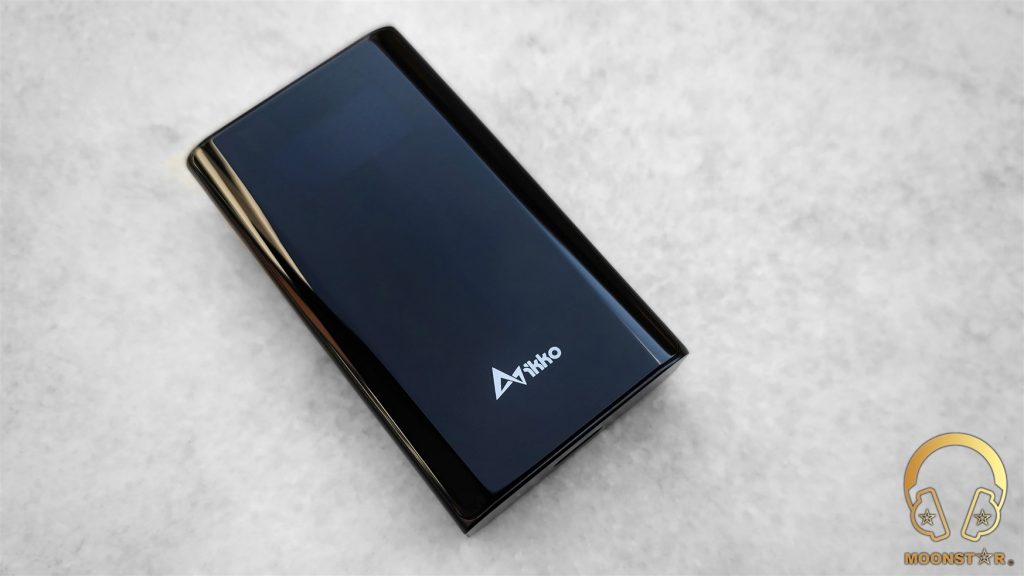
The IKKO Heimdallr ITB03 is a capable portable Bluetooth DAC/amp with dual Asahi Kasei AK4377 DACs and RT6863 amplification, offering optical output and filter options. Compared to the BTE-9, the ITB03 presents a slightly warmer, more colored tonality, which can suit certain genres but reduces overall neutrality. Subbass extension is solid on both, but the BTE-9 achieves tighter control and faster transients, preventing minor bloom during deep passages. Midbass on the TimeEar is more precise and layered, particularly with the Oriveti Bleqk Purecaster, where the ITB03’s warmth can slightly soften rhythmic separation.
The BTE-9’s midrange is more forward and resolved, delivering greater vocal presence and micro-dynamic detail, while the ITB03 provides fuller lower mids that benefit acoustic instruments but may introduce congestion in dense arrangements. Treble extension slightly favors the BTE-9 with better air and control; the ITB03 offers filter adjustments but can become brighter without tuning, potentially fatiguing with the ZiiGaat Horizon. Soundstage dimensions are similar, though the BTE-9 offers marginally better imaging stability in balanced mode. Battery life on the TimeEar is substantially longer, often double the ITB03’s 6 to 8 hours under LDAC. Bluetooth performance is comparable in stability, but the BTE-9 handles multi-point transitions more smoothly.
Power delivery clearly favors the BTE-9 at 240 mW balanced, driving loads like the SIVGA Peng with ease where the ITB03’s 125 mW may show strain. At similar pricing, the BTE-9 provides greater refinement for critical listening, while the ITB03 suits users needing optical output or filter flexibility.
TimeEar BTE-9 versus iFi GO Blu:
The iFi GO Blu is a respected ultra-portable Bluetooth DAC/amp with balanced design and strong codec support, known for its musical tuning. The BTE-9, however, matches and often exceeds it in several key areas, especially for value-conscious users. The GO Blu adopts a warmer, more romantic tone with subtle euphonic enhancement, while the BTE-9 maintains greater neutrality and source fidelity, making it better suited for analytical playback. Subbass depth is comparable, but the BTE-9 delivers tighter midbass control and quicker transients, producing cleaner percussion impact through the ZiiGaat Horizon.
Midrange on the TimeEar is more detailed and forward, with superior vocal resolution and nuance, the Oriveti Bleqk Purecaster reveals breathy subtleties with clarity, whereas the iFi’s fuller lower mids add warmth but can obscure fine textures. Treble extension on the BTE-9 reaches further with added air and sparkle, retrieving upper harmonics accurately without sibilance; the GO Blu rolls off earlier for smoother presentation, which may appeal in bright recordings but sacrifices some detail.
Soundstage favors the BTE-9 with wider, deeper imaging and precise layering, surpassing the GO Blu’s more intimate staging. Battery life, output power, and Bluetooth reliability are significantly better on the BTE-9, sustaining over 18 hours on LDAC and driving the SIVGA Peng with composure where the iFi may compress at high volumes. Although the GO Blu includes features like XBass and app EQ, the BTE-9 offers superior raw performance, build quality, and endurance at a lower cost, making it a stronger daily choice for transparent, long-lasting portable audio.

Conclusion:
The TimeEar BTE-9 is a well-integrated, portable audio solution that features interesting internal components and a practical, premium design. It delivers competent sonic performance coupled with solid build quality and a stable Bluetooth connection. Notably, its excellent battery performance provides sustained usage, ensuring consistent operation with sufficient power and musicality whether used wirelessly for portability or wired in a desktop setting. Considering its price, it offers strong value and versatility, making it a highly recommended option for users seeking a compact, high-performance DAC/amplifier.
Pros & Cons:
- + Powerful and clean balanced output
- + Dynamic, musical tuning with strong technical performance for the price
- + Excellent battery life and fast charging
- + Rock-solid Bluetooth with full hi-res codec support
- + Premium CNC aluminum and glass construction
- + Informative OLED display and intuitive controls
- + Outstanding price-to-performance ratio
- – Companion app limited to Android and lacks advanced features
- – USB DAC mode capped at 48 kHz on standard system paths (hoping for a firmware update)
- – 4.4mm balanced jack is very tight
Thank you for the Read!