Nobsound P10 Pro Review
Nobsound P10 Pro Review
Introduction:
Douk Audio has spent the better part of a decade building the Nobsound brand around a simple and consistent premise: bring genuine tube amplification to portable audio at a price that makes the technology accessible rather than aspirational. The P10 Pro is the latest iteration of that ambition. It does not attempt to be a Swiss Army knife with Bluetooth, a built-in DAC, or app connectivity. It is, by design, a purely analog device: a portable headphone amplifier built around a hybrid circuit combining Raytheon JAN6418 directly heated triode vacuum tubes with a NE5532 operational amplifier, housed in a compact CNC-machined aluminum chassis, powered by two replaceable 14500 lithium batteries. Everything about it is oriented toward a single goal: adding the warmth, harmonic density, and organic character of tube amplification to whatever source the listener already has.
Priced slightly above the $100 mark, the P10 Pro is not positioned as a budget curiosity. It is a serious, customizable platform. Both the tubes and the op-amp are user-swappable without tools, allowing the listener to experiment with rolling alternative components, a practical advantage that meaningfully extends the device’s tonal range without requiring additional hardware. The question this review addresses is how the P10 Pro performs as a daily-use portable amplifier in a genuinely demanding context: paired with sources of known quality and with headphones and IEMs that reveal differences in amplification clearly.

Disclaimer:
I would like to thank Douk Audio for providing the Nobsound P10 Pro as a review sample. I am not affiliated with Douk Audio or Nobsound beyond this review, and these words reflect my true and unaltered opinions about the product.
Price & Availability:
The Nobsound P10 Pro is priced at $109,99 USD. It is available directly through the Douk Audio website and authorized retailers. For more details, please refer to the link below:
Package & Accessories:
The P10 Pro arrives in a functional cardboard box without elaborate presentation. The product has been kept compact and the packaging reflects that priority without attempting to compensate through cosmetic embellishment. Inside, the amplifier is protected by a foam-lined insert. The included accessories are directly practical: everything required to get the device running immediately is present, along with one tool for accessing the internal battery and component compartment.

The full package includes:
- 1 x Nobsound P10 Pro Portable Tube Headphone Amplifier
- 1 x 3.5mm to 3.5mm Analog AUX Cable (for source connection)
- 1 x USB Type-C Charging Cable
- 1 x Torx Screwdriver (for removing the rear cover to access batteries, tube and op-amp)
- 2 x Rubber Bands (for stacking the amplifier to a DAP or smartphone)
- 1 x User Manual and Warranty Card
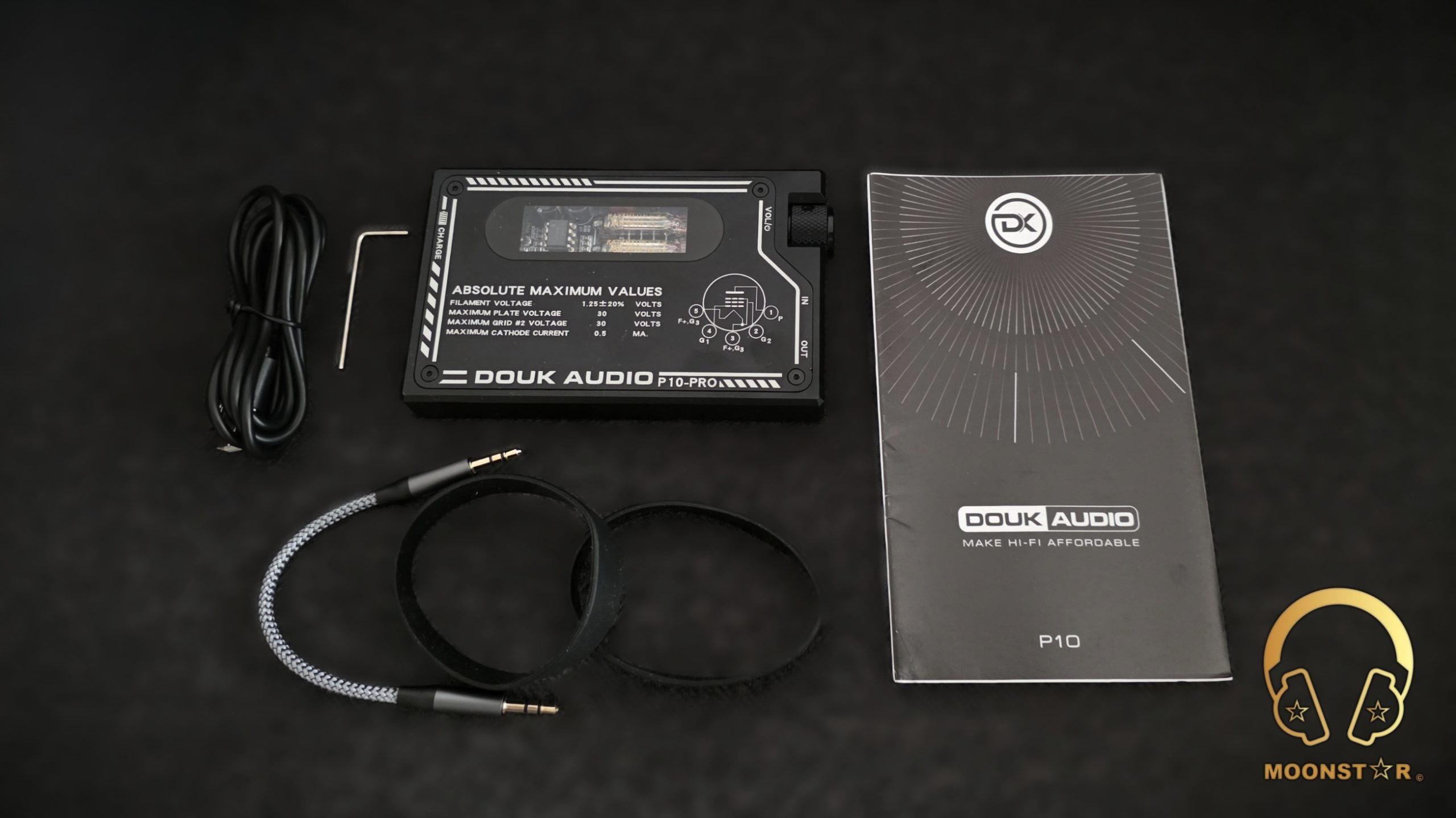
The rubber bands and AUX cable are the two most immediately useful inclusions, allowing the P10 Pro to be strapped directly to a DAP or phone for portable use from the moment of unboxing. The Torx screwdriver reflects the device’s open, modifiable design: the rear cover is secured with two screws and removes in under a minute to expose the battery compartment and the tube and op-amp sockets.
The absence of a carrying case or a soft pouch is the most practical limitation of the package, and users who carry the P10 Pro daily will want to source a small protective sleeve separately. The overall bundle suits the product’s identity as a tool rather than a lifestyle accessory, and it delivers everything necessary for both immediate use and the tube and op-amp rolling that many owners will want to explore.

Design & Build Quality:
The P10 Pro is a compact, dense, and purposeful device with an unambiguously industrial form factor. Measuring 120mm wide by 75mm deep and 18mm tall, it is smaller than most mid tier DAPs, yet its 252 gram weight reflects the density of its CNC machined aluminum alloy chassis. The weight is well distributed, ensuring the device sits firmly when rubber banded to a source for portable use. Every design decision reflects its functional intent: a flat, rectangular box built for durability rather than decorative styling.

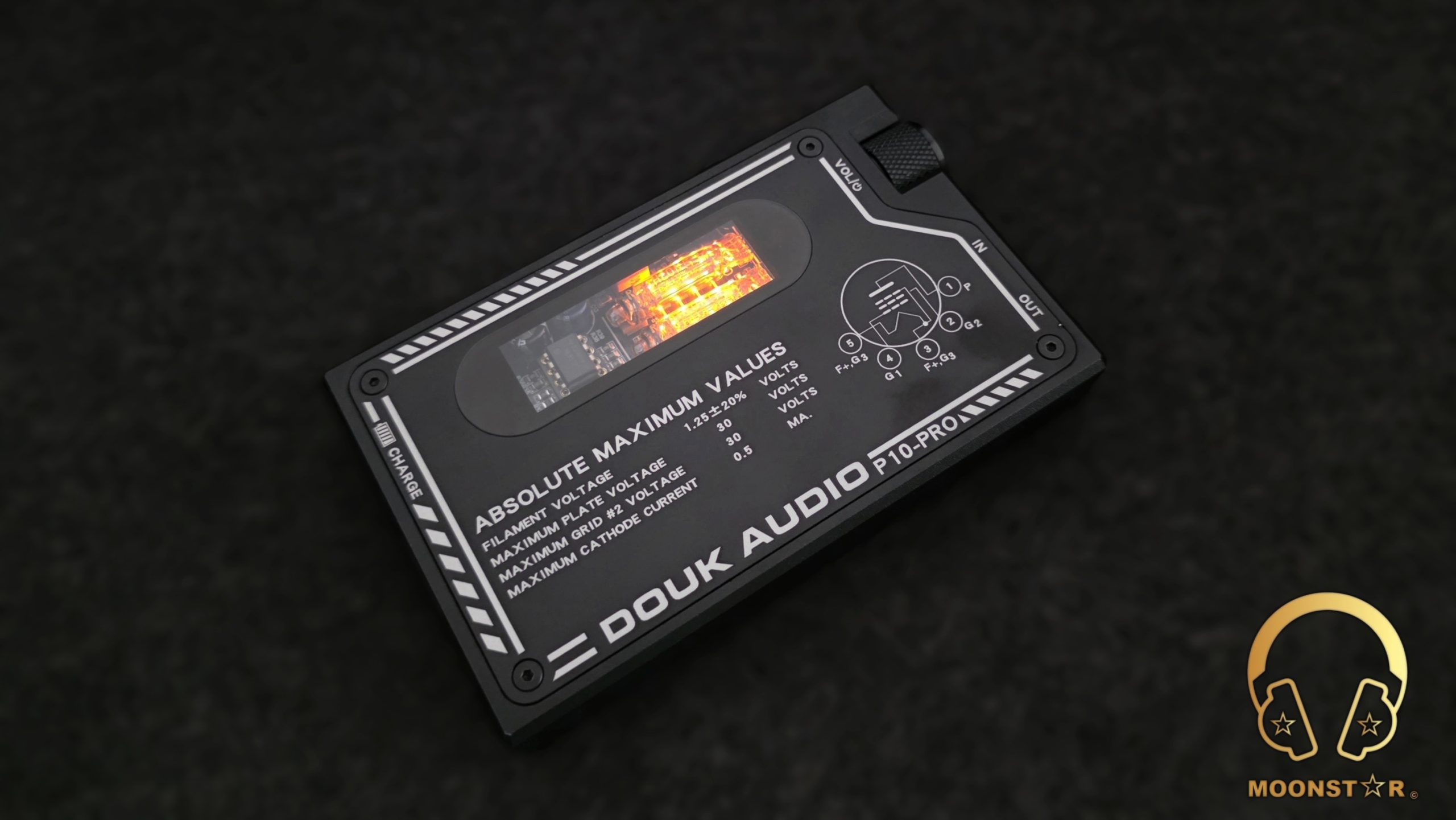
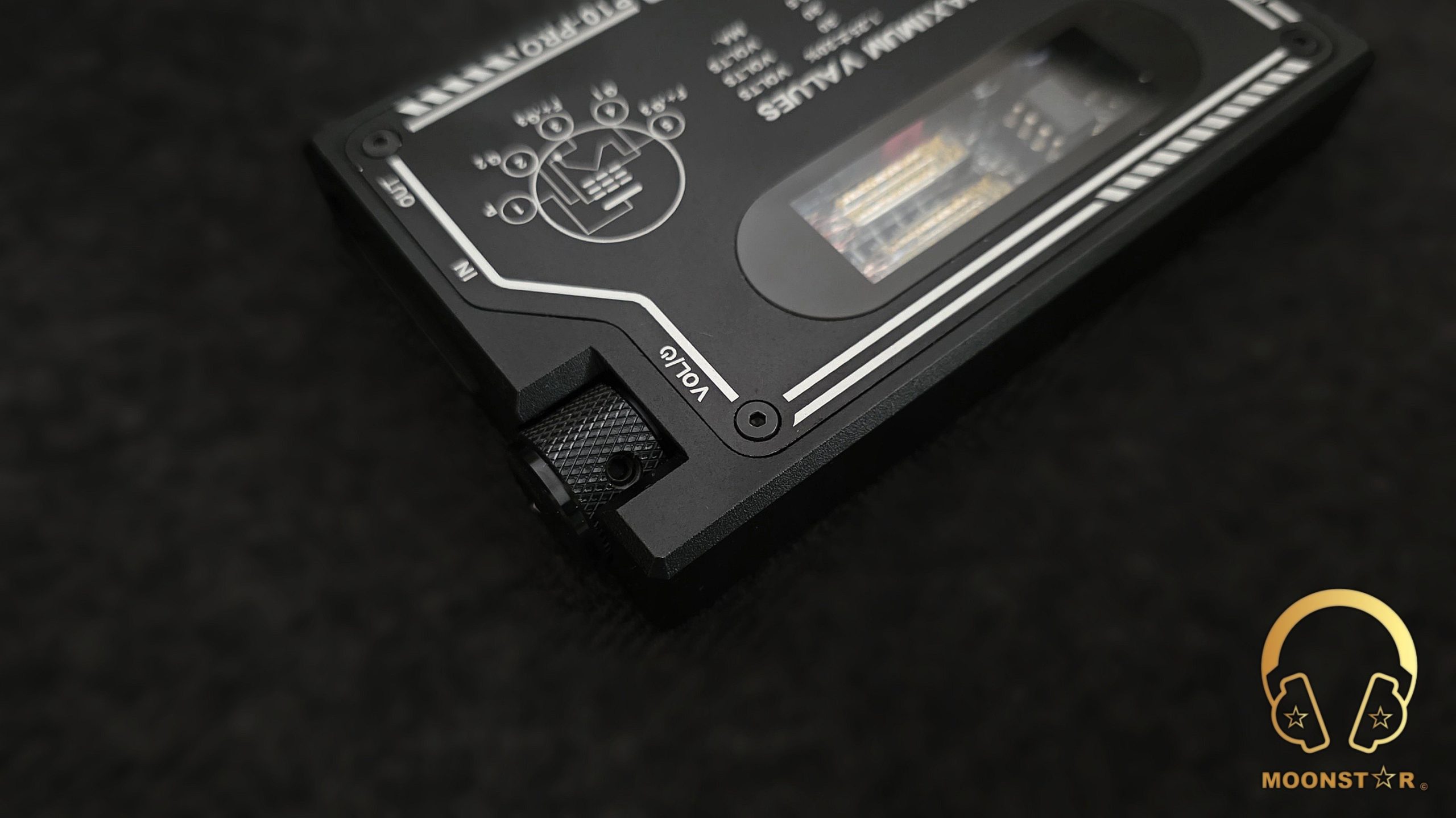
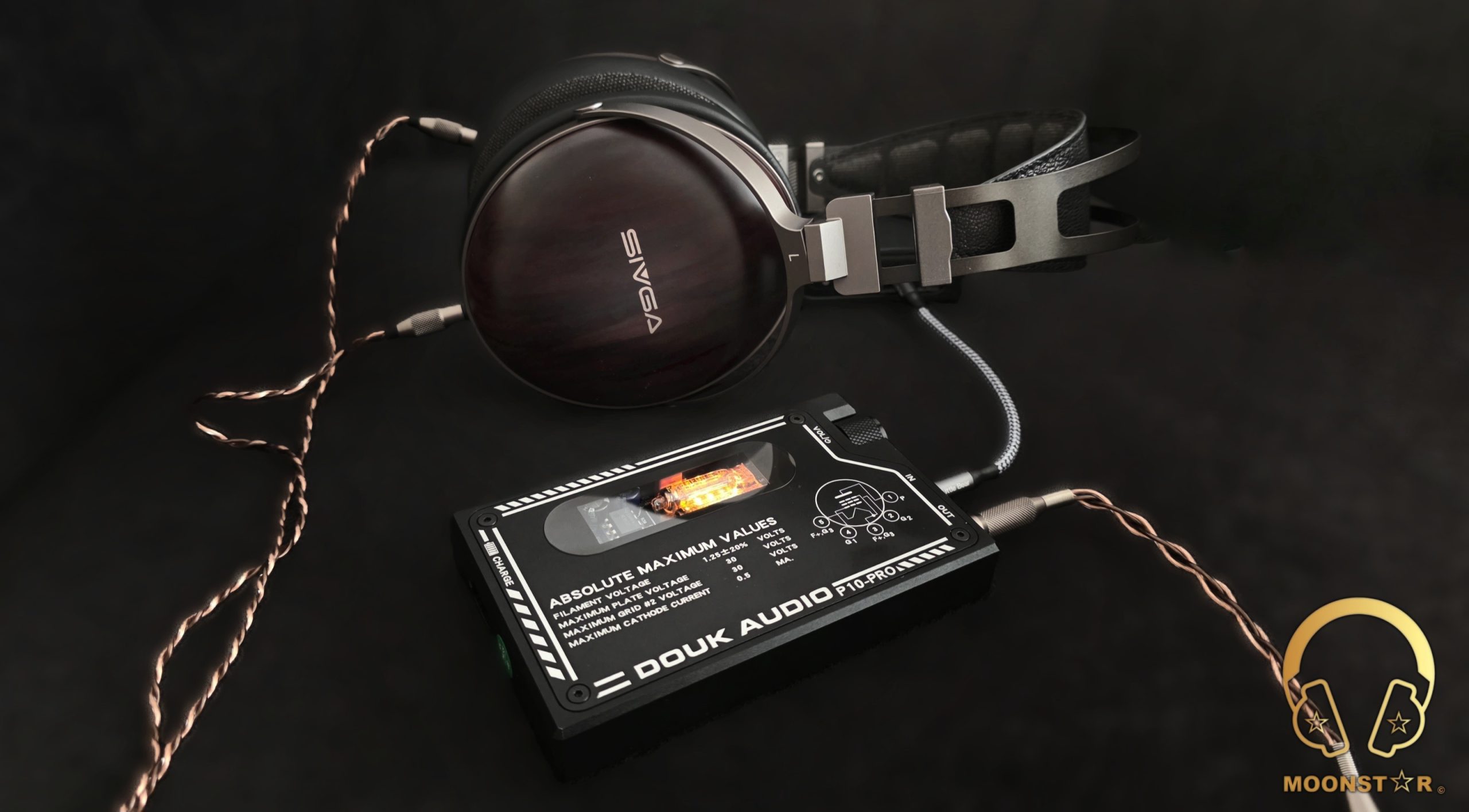
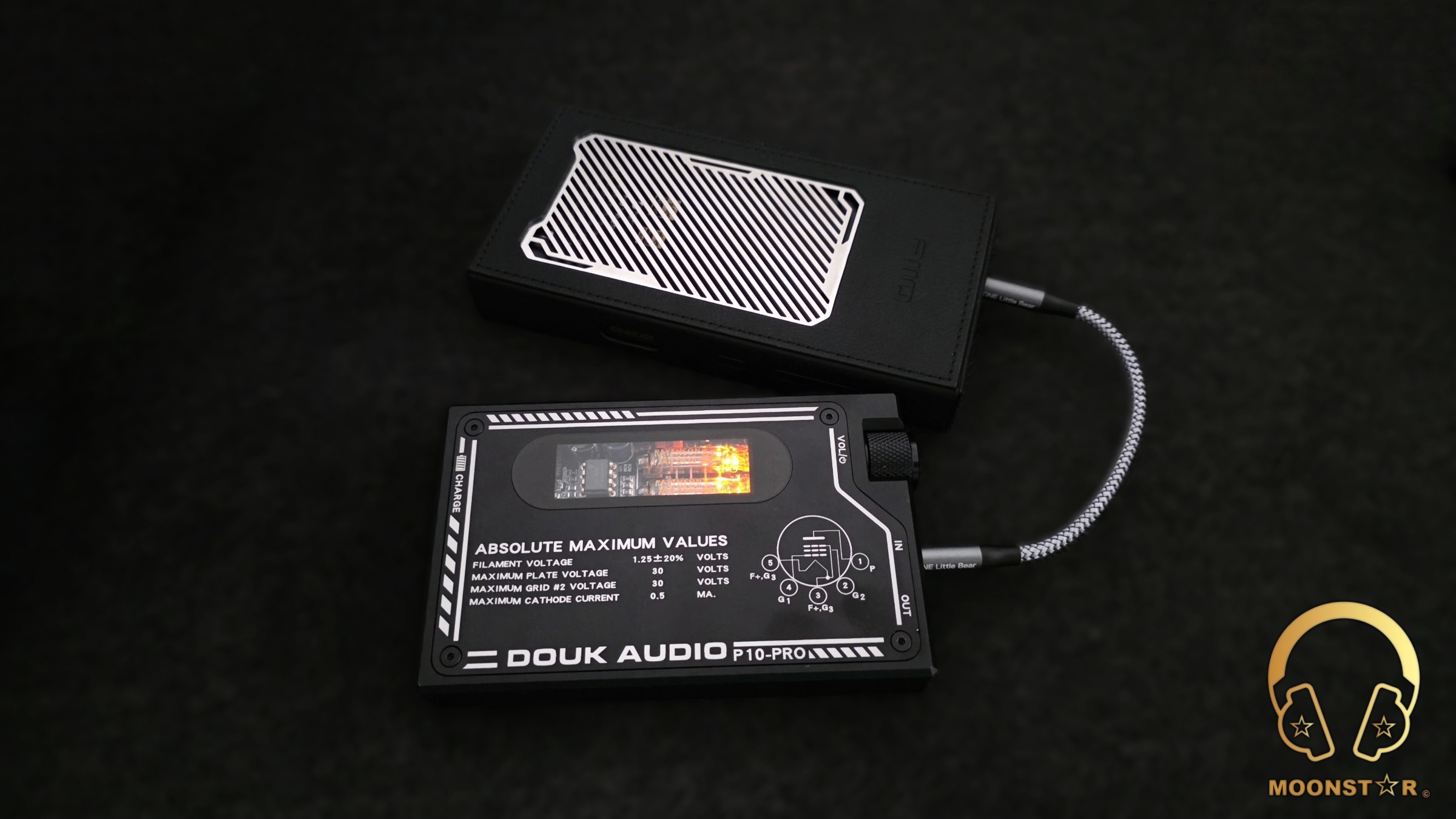
The top panel is the most distinctive surface, featuring a transparent acrylic window that reveals two JAN6418 tubes and an NE5532 op amp. When powered on, the tubes emit a soft amber glow that provides direct confirmation of operation. Above this window, technical reference data and a simplified circuit schematic are printed directly on the panel, offering useful information for those interested in tube rolling. A five segment LED battery indicator is also mounted here, allowing the user to check charge levels from 0 to 100 percent at a glance without waking a screen.
The front panel houses the primary controls and connections. The 3.5mm headphone output is recessed into the panel face to provide strain relief, though this may limit compatibility with larger diameter or L shaped plugs.

Centrally located is the combined power and volume knob, a solid aluminum potentiometer with a smooth, well damped rotation that ensures precise adjustments without channel imbalance. To the right sits the 3.5mm analog input, while a small red LED provides a clear status indicator that remains visible even when the top panel is obstructed.
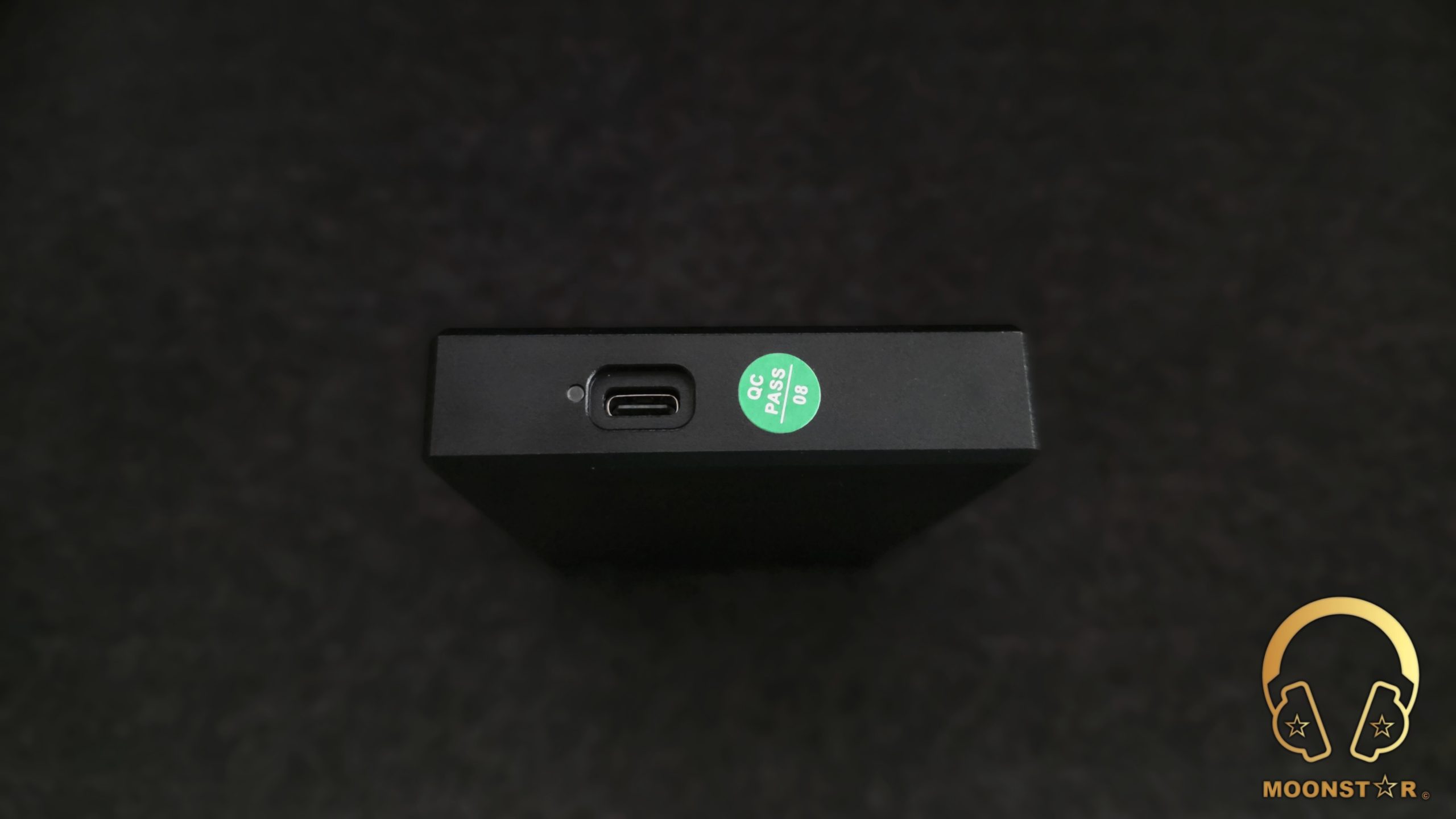
The rear panel carries a USB Type C port that supports both charging and play while charging functionality. Two Torx screws at the edges secure the rear cover, which, once removed, provides full access to the battery tray holding two 14500 cells, the tube sockets, and the op amp socket. These internal components are color coded and labeled, making battery or component swaps straightforward with the included tool.
Overall build quality is notably solid for the price point. The side panels feature shallow milled grooves for improved grip and dedicated channels for rubber band retention. With tight tolerances, a wobble free volume knob, and internal WIMA capacitors, the P10 Pro feels like a professional tool built to withstand regular handling and travel. The impression is one of functional reliability, prioritizing audio signal integrity and hardware accessibility over visual statements.

Technical Specifications:
- Model: P10 Pro
- Circuit Type: Hybrid Tube + Op-Amp (Vacuum Tube with Operational Amplifier)
- Tubes: 2 x Raytheon JAN6418 Directly Heated Triode (replaceable; compatible with CK6418, CK548DX)
- Op-Amp: 1 x NE5532 Dual Op-Amp (replaceable; compatible with JRC4558, JRC4556, OPA2604, OPA2111, MUSES02)
- Output Power: 170mW at 32 Ohms
- Frequency Response: 20Hz to 20kHz
- THD: Less than 0.1%
- SNR: 75dB
- Gain: 12dB
- Maximum Input Level: 1.0 Vrms
- Maximum Output Level: 2.5 Vrms
- Compatible Headphone Impedance: 16 to 200 Ohms
- Audio Input: 3.5mm TRS Analog (single input)
- Audio Output: 3.5mm TRS Headphone (single output, recessed)
- Battery: 2 x 14500 Li-ion, 3.7V, 600mAh each (total 1200mAh), user-replaceable
- Battery Life: 8 to 10 hours (varies with volume level)
- Battery Indicator: 5-level LED (0% / 25% / 50% / 75% / 100%)
- Charging: USB Type-C, standard 5V DC (fast charging not supported), full charge approx. 2.5 to 3 hours
- Play While Charging: Yes
- Dimensions: 120mm x 75mm x 18mm
- Weight: 252g
- Chassis: CNC-Machined Aluminum Alloy
- Internal Capacitors: WIMA
Warm-Up and Operational Notes:
The JAN6418 is a directly heated triode, and this driver type introduces two practical operational characteristics that new owners should be aware of before initial use. First, the tubes require a brief stabilization period after power-on before they settle into their operating state. During this stabilization, a soft resonant tone, often described as a fading ring or hum, may be present for approximately 25 to 35 seconds after switching on. This is entirely normal behavior for directly heated tubes and diminishes as the tube heats to its operating temperature. Second, the direct-heating topology makes the tube physically sensitive to vibration and mechanical shock. Tapping the chassis, dropping the device, or subjecting it to significant vibration while powered on can cause the tubes to ring briefly. This microphonic sensitivity is a known property of directly heated triode tubes rather than a product defect, and it does not affect performance under normal listening conditions.
For best results, the P10 Pro benefits from allowing 3 to 5 minutes of warm-up time after powering on before critical listening begins. The sonic character of the amplifier subtly develops during this period, with the tubes settling into a more stable and fully voiced presentation as they reach operating temperature. Charging should always use a standard 5V DC supply; fast chargers can cause cell stress in the 14500 format and should be avoided. When storing the device for extended periods, removing the batteries is recommended to prevent discharge-related issues.
Op-Amp and Tube Rolling:
The P10 Pro’s open socket design invites rolling alternative components, and this represents a genuine extension of the device’s sonic range that is worth discussing honestly. The default NE5532 op-amp is a capable and well-regarded part, but it has a character that some listeners find slightly grainy in the upper midrange and treble under demanding conditions. Rolling to alternative op-amps can produce a meaningfully cleaner and more refined presentation. The stock Raytheon JAN6418 is a quality starting point that most listeners will find satisfying without modification. For those who wish to explore, the process requires only the included Torx screwdriver, a few minutes, and careful handling of the component pins.
Battery Life:
Battery life in real-world use falls between 8 and 10 hours depending on volume level and headphone impedance load. With IEMs at moderate volume levels, the upper end of this range is achievable. With the SIVGA Peng’s 340-ohm impedance requiring higher volume settings to reach adequate listening levels, the lower end is more realistic. The five-LED battery indicator provides a reliable readout of the remaining charge without requiring any interaction with a screen or button, and the LED status is visible at a glance from any angle when looking at the top panel.
Charging takes approximately 2.5 to 3 hours from near-empty using a standard 5V DC supply. The play-while-charging functionality operates without audible noise or interference, making it practical to use the device during a desk charging session. The replaceable battery design extends the useful life of the device meaningfully: when cells eventually lose capacity after several years of use, standard 14500 cells of the same brand and capacity can be purchased and fitted using the included Torx screwdriver. This is a practical longevity feature that distinguishes the P10 Pro from sealed devices that retire with their original batteries.
Equipment Used for This Review:
- Portable Amplifier : Nobsound P10 Pro
- Sources : FiiO M33 R2R (line-out mode), iBasso DX260 MK2 (line-out mode)
- IEMs : ZiiGaat x Fresh Reviews Arete II, Noble Audio Knight
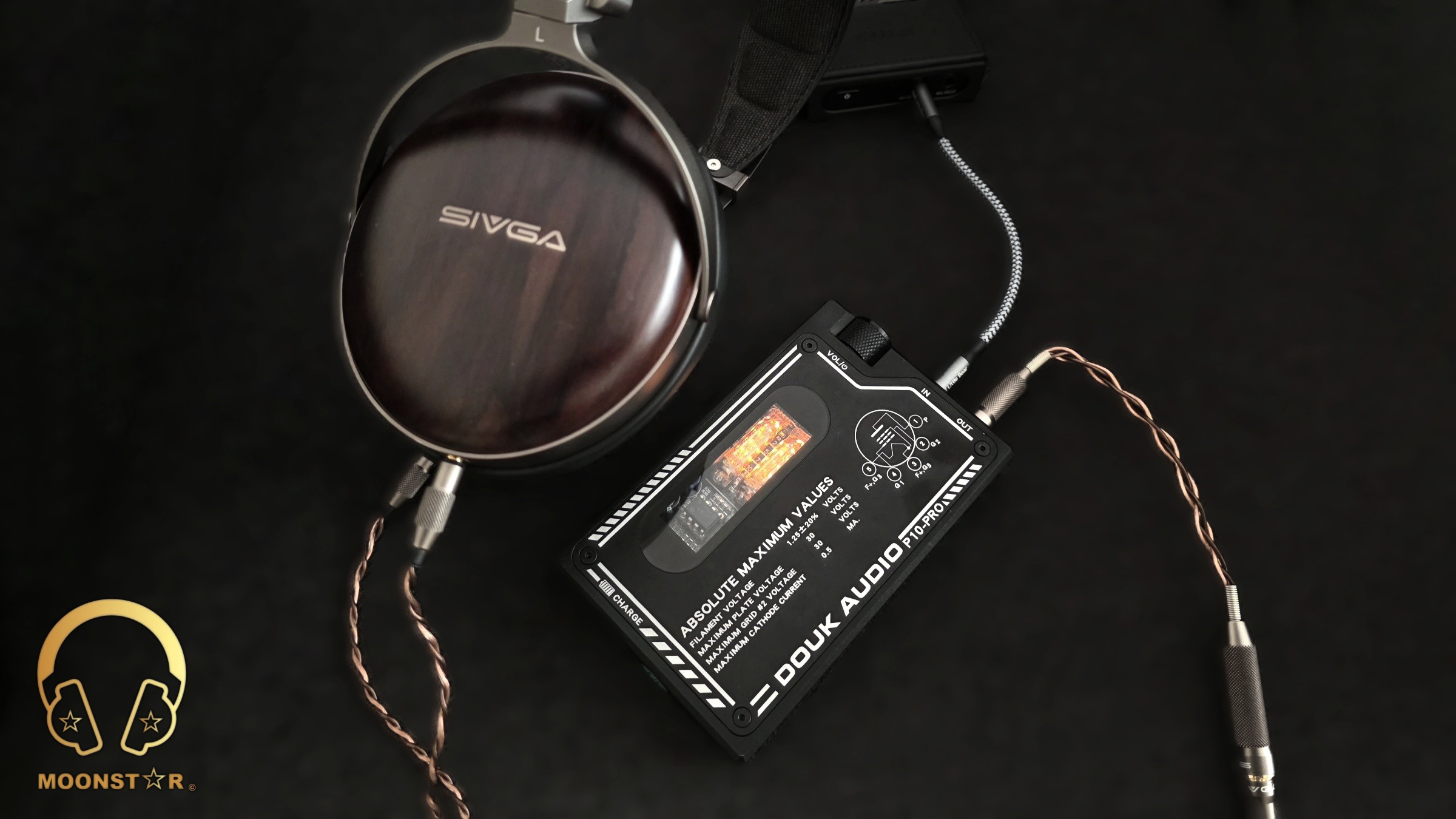
- Headphones : Fosi Audio i5 (open-back planar), SIVGA Peng

Albums & Tracks Used for This Review:
- Norah Jones – Come Away With Me (Apple Music Lossless)
- Adele – My Little Love (Apple Music Lossless)
- Sarah McLachlan – Angel (FLAC 24bit/48kHz)
- Sertap Erener – Ask (FLAC 16bit/44.1kHz)
- Edith Piaf – Non Je Ne Regrette Rien (FLAC 16bit/44.1kHz)
- Diana Krall – So Wonderful (DSF)
- Aretha Franklin – I Say A Little Prayer (FLAC 24bit/96kHz)
- Michael Jackson – Billie Jean (FLAC 24bit/96kHz)
- George Michael – Don’t Let the Sun Go Down on Me (FLAC 24bit/192kHz)
- David Bowie – Heroes (FLAC 24bit/192kHz)
- Elton John – Rocket Man (FLAC 24bit/96kHz)
- Barry White – Just The Way You Are (FLAC 24bit/48kHz)
- Isaac Hayes – Walk On By (FLAC 16bit/44.1kHz)
- Sting – Englishman in New York (FLAC 24bit/48kHz)
- Eric Clapton – Wonderful Tonight (FLAC 24bit/96kHz)
- Dave Gahan – Kingdom (Tidal Hi-Fi)
- Radiohead – Live in Berlin (Apple Music Lossless)
- Radiohead – Pyramid Song (Apple Music Lossless)
- U2 – Sunday Bloody Sunday (FLAC 16bit/44.1kHz)
- Muse – Hysteria (FLAC 24bit/96kHz)
- Red Hot Chili Peppers – Nobody Weird Like Me (FLAC 24bit/48kHz)
- Bear McCreary – Valkyries (Deezer HiFi)
- Bro Safari, UFO! – Drama (Deezer HiFi)
- Armin Van Buuren – Vini Vici (FLAC 16bit/44.1kHz)
- Daft Punk – Instant Crush (FLAC 24bit/96kHz)
- Daft Punk – Doin’it Right (FLAC 24bit/96kHz)
- Lorde – Royals (FLAC 24bit/48kHz)
- Massive Attack – Angel (FLAC 24bit/48kHz)
- Toutant – Rebirth (Deezer HiFi)
- Gogo Penguin – Raven (FLAC 24bit/192kHz)
- Gogo Penguin – Murmuration (FLAC 24bit/192kHz)
- Portishead – It Could Be Sweet (Apple Music Lossless)
- Hans Zimmer – The Dark Knight OST (FLAC 24bit/96kHz)
- Max Richter – On the Nature of Daylight (FLAC 24bit/96kHz)
- Charly Antolini – Duwadjuwandadu (FLAC 24bit/192kHz)
- Tchaikovsky – Symphony No. 5 (FLAC 16bit/44.1kHz)
- Ferit Odman – Look, Stop & Listen (FLAC 24bit/192kHz)
- Chopin – Nocturne No. 20 in C-Sharp Minor (FLAC 16bit/44.1kHz)
- Clair de Lune – Claude Debussy (Spotify)
- Fazil Say – Nazim Oratoryosu (Live) (FLAC 16bit/44.1kHz)
- Vivaldi – Le Quattro Stagioni (Apple Music Lossless)
- Pink Floyd – Shine On You Crazy Diamond (Apple Music Lossless)
- Miles Davis – So What (Deezer HiFi)
- Otto Liebert & Luna Negra – The River (FLAC 24bit/192kHz)
- Lunatic Soul – The Passage (FLAC 16bit/44.1kHz)
- Deftones – My Own Summer (Shove it) (FLAC 16bit/44.1kHz)
- Metallica – Dyers Eve (FLAC 24bit/96kHz)
- Metallica – Sad but True (FLAC 24bit/96kHz)
- Opeth – Windowpane (FLAC 16bit/44.1kHz)
- Megadeth – Sweating Bullets (Tidal Hi-Fi)
- Rush – Tom Sawyer (FLAC 16bit/44.1kHz)
- Slayer – Angel of Death (Spotify)
- Liquid Tension Experiment 2 – Acid Rain (Spotify)
- Yosi Horikawa – Bubbles (Spotify)
The Sound:
All sound impressions were formed using source devices in line out mode, which bypasses the source’s own headphone amplifier stage to route only the DAC output signal to the P10 Pro. This is the recommended usage method for any portable amplifier, ensuring that the sonic contribution of the tube and op amp circuit is assessed independently from the source’s own output stage. The FiiO M33 R2R served as the primary source due to its organically voiced R2R DAC architecture, while the iBasso DX260 MK2 was used for cross referencing given its more analytically tuned delta sigma chain.
The P10 Pro’s character is immediately identifiable across all pairings as warm, harmonically dense, and smooth. These qualities originate from the JAN6418 tube’s contribution to the signal chain. The directly heated triode adds a degree of second harmonic richness to the output that is audibly different from the cleaner, less colored presentation of solid state amplifiers. This is not distortion in a negative sense; it is the harmonic texture historically associated with tube amplification, implemented here in a way that feels natural and musically appropriate. The NE5532 op amp handles the more demanding aspects of signal delivery, creating a hybrid result that is warmer and more organic than solid state alone while remaining more dynamically capable and controlled than a pure tube design of this size.

Bass:
The bass character of the P10 Pro is one of its most immediately engaging qualities. The combination of the JAN6418 tube and the NE5532 op amp produces a low end with genuine physical weight and tonal density without losing structural definition. This is not a bass boosted presentation in the sense of a frequency shelf; rather, it is the natural consequence of the tube’s harmonic contribution filling in the space around bass notes with additional tonal body. The result is that bass lines gain a sense of physical substance and presence that the same transducers produce to a lesser degree when connected directly to the DAC output of either source.
Sub bass reaches down with authority when the material calls for it. Electronic music with sustained low frequency content, cinematic material with deep orchestral bass, and acoustic double bass in jazz recordings all benefit from the P10 Pro’s treatment. The sense of pressure and physical resonance in the lower registers is more convincingly communicated through the P10 Pro than directly from the M33 R2R or DX260 MK2 headphone outputs. Mid bass has a rounded, slightly warm character with a leading edge that communicates impact clearly, while the decay carries the natural bloom of tube amplification rather than the drier resolution of solid state designs. Kick drums have a satisfying fullness and weight that suits rock, jazz, and acoustic material particularly well.
Pairing matters significantly in the bass region. With the Fosi Audio i5, the P10 Pro’s warmth complements the planar driver’s inherently fast, linear bass character, adding tonal body to a driver that can sound slightly lean on mid bass weight through clinical solid state amplification. The combination produces a bass presentation that is both controlled and full. With the SIVGA Peng’s 340 ohm driver, the P10 Pro’s 170mW output at 32 ohms is not the most powerful match on paper, but the Peng’s 102dB sensitivity means adequate volume is achievable, and the tube’s warmth adds a pleasing density to the Peng’s own warm character.

Midrange:
The midrange is the region where the P10 Pro makes its most compelling and sustained impression, and it is where the tube circuit’s contribution is most musically rewarding. The JAN6418 adds a harmonic density to midrange content that gives voices and instruments a sense of physical presence and tonal weight that direct DAP output does not replicate with the same character. This quality is the result of the tube’s natural second harmonic enrichment, which gives sustained notes an additional layer of tonal body that sounds organic and resolved rather than processed. Female vocals are the most immediate demonstration of this character. Voices in the soprano range acquire a warmth and a physical presence that places them convincingly in an acoustic space. The subtle breath and resonance that distinguish a genuine vocal performance are communicated with a fidelity that draws the listener closer to the material. Upper midrange presence is handled with restraint; the tube circuit does not impose excessive warmth on the top of the vocal register, which means bright or forward female voices retain their natural projection without becoming thick. Male vocals benefit equally; deep baritone voices gain the appropriate low mid body they demand, sitting in the mix with genuine weight and resonance rather than the slightly thin, linear quality of solid state outputs.
With the Noble Audio Knight, the P10 Pro’s midrange warmth pairs very well with the Sonion balanced armature’s transparent character. The tube’s harmonic density fills in some of the BA’s characteristic leanness in the lower midrange without softening the clarity that makes the Knight’s midrange its primary strength. The ZiiGaat Arete II, with its slightly boosted midrange via the Knowles drivers, also receives the P10 Pro’s warmth with good results; vocals gain additional body and the intended midrange presence is further enriched rather than over weighted. Instrumental midrange reproduction is equally strong; acoustic guitar body resonance is communicated with a physical quality that reinforces the sense of an instrument being played in a room.
Treble:
The treble of the P10 Pro reflects the hybrid circuit’s character: it is extended and detailed, but presented with a smooth, slightly warm quality that never ventures into harshness or fatigue. The JAN6418 tube adds a natural smoothness to the upper frequencies that attenuates the tendency toward analytical edge introduced by some solid state amplifiers. The result is a top end that conveys the detail content of recordings with good clarity while maintaining a comfortable, non tiring character across extended listening sessions. Cymbal reproduction communicates the essential metallic texture and shimmer of percussion clearly, with enough transient definition to track the timing and character of complex work without imposing a sharp quality on the leading edges. In jazz and classical recordings, cymbal work sits naturally in the mix, contributing spatial and rhythmic information without dominating the foreground. Upper treble extension is present and contributes a sense of air and openness to the presentation, but it is voiced with restraint rather than prominence. The top octave above 10kHz provides the sense of space and atmospheric resolution that recordings of acoustic environments require without asserting itself independently.
With the Fosi Audio i5, the P10 Pro’s treble smoothness pairs well with the planar driver’s inherently fast, extended high frequency character. The i5’s upper midrange, which can become tiring on brighter amplification, benefits from the P10 Pro’s smoothing effect, retaining speed and detail while removing the occasional edge. The Noble Knight’s piezoelectric super tweeter, which contributes a smooth but extended top end, integrates seamlessly with the P10 Pro’s treble character, producing an airy, natural upper frequency range that suits classical and jazz material very comfortably.

Soundstage and Imaging:
The P10 Pro contributes positively to the spatial presentation of all four transducers used in this review. The tube circuit adds a quality of depth and three-dimensionality to the soundstage that gives recordings a more convincing sense of acoustic space. Width is moderately expanded compared to direct DAP output, but the most audible spatial improvement is in depth: the sense of front-to-back layering within complex arrangements is more convincingly rendered, with instruments placed at more clearly differentiated distances from the listener. This depth quality is characteristic of tube amplification generally and is one of the more musically rewarding aspects of the P10 Pro’s contribution to the listening experience.
Imaging precision is solid, with stable and well-defined instrument positions that do not blur during complex passages. The background noise floor with the two IEMs used in this review, the Noble Knight and the ZiiGaat Arete II, is audible at very low volume in very quiet environments, which is a known characteristic of the directly heated tube topology and the NE5532 op-amp combination. At normal listening levels and with music playing, this floor is completely inaudible. Listeners using particularly sensitive IEMs, such as those rated above 115dB SPL, may find the noise floor more apparent and should evaluate this characteristic before committing to the combination.
Comparisons:
Nobsound P10 Pro vs. FiiO M33 R2R (Line-out):
Comparing the P10 Pro with the FiiO M33 R2R’s own headphone output, fed from the M33 R2R’s line-out to the P10 Pro, reveals the nature of the amplifier’s sonic contribution in the most controlled possible context. The M33 R2R’s headphone output is itself a capable and musically voiced stage, benefiting from the R2R DAC’s organic character and the TI op-amp amplifier’s clean output. Adding the P10 Pro into the chain produces a presentation that is measurably warmer and harmonically denser, with a more pronounced bass body and a midrange that carries additional tonal weight around sustained notes and vocals. The treble is somewhat softened relative to the M33 R2R direct output, which is already smooth by delta-sigma standards, and the combined result leans further into warmth and musical engagement than technical precision.
For listeners who find the M33 R2R direct output already satisfying and balanced, the P10 Pro’s addition may push the character further toward warmth than is ideal for neutral or reference-oriented listening. For those who prefer a more organic, tonally rich presentation, the combination is genuinely compelling and represents a meaningful upgrade in musical character if not in raw technical specification. The P10 Pro adds approximately 12dB of fixed gain, which means volume control on the source must be managed carefully to avoid clipping at the input stage, and the line-out level of the M33 R2R should be set conservatively before adjusting the P10 Pro’s volume knob.
Nobsound P10 Pro vs. iBasso DX260 MK2 (Line-out):
The iBasso DX260 MK2’s headphone output, built around the CS43198 octa-DAC matrix, has a more analytically inclined character than the M33 R2R: it is cleaner, more precise in its transient delivery, and slightly leaner in the lower midrange. These qualities make the DX260 MK2 an excellent pairing for the P10 Pro, because the tube amplifier’s warmth and harmonic density complement the DX260 MK2’s more clinical baseline more directly than they do the M33 R2R’s already-warm R2R character. The combination of the DX260 MK2 line-out and the P10 Pro produces a sound that takes the analytical precision of the CS43198 DAC and adds the tonal body and midrange richness that makes it more engaging for long listening sessions without sacrificing the clarity and transient definition that the delta-sigma architecture provides. This pairing is arguably the more synergistic of the two source combinations, and listeners who already own the DX260 MK2 may find the P10 Pro a more transformative addition to their setup than those using the already-warm M33 R2R.
Conclusion:
The Nobsound P10 Pro is a well-executed and purposefully designed portable tube amplifier that delivers a genuine and musically meaningful contribution to the listening experience. Its hybrid tube and op-amp circuit produces a sonic character that is warm, harmonically rich, and engaging without crossing into excessive coloration or loss of control. The bass gains physical weight and density. The midrange acquires tonal body and presence that makes vocals and acoustic instruments more convincing and emotionally involving. The treble is smooth and fatigue-free, communicating detail and air without the analytical edge that can make extended listening sessions uncomfortable. Soundstage gains depth and a sense of three-dimensional space that tube amplification consistently contributes when implemented thoughtfully.
The practical case for the P10 Pro is supported by its user-replaceable batteries, swappable tubes and op-amp, solid CNC aluminum build, and a battery life of 8 to 10 hours. The device is honest about what it is: a specialized tool for listeners who want tube character in a portable format, not a feature-rich Swiss Army knife. The 3.5mm-only connectivity, the modest output power ceiling, the lack of a carrying case, and the microphonic sensitivity inherent to directly heated tubes are real limitations that require consideration before purchase. For listeners who approach the P10 Pro with accurate expectations and compatible transducers in the 16 to 200-ohm range, it is a product that rewards daily use and delivers a consistently enjoyable listening experience at $109,99 USD.
Pros & Cons:
- + Genuine tube warmth and harmonic density adds real and musically meaningful character to both IEMs and headphones
- + Bass gains physical weight and tonal body without losing structural definition
- + Midrange is warm, natural, and harmonically rich; particularly rewarding with vocal and acoustic instrumental material
- + Smooth, fatigue-free treble with no sibilance across extended listening sessions
- + Soundstage gains convincing depth and three-dimensional quality from the tube circuit’s contribution
- + User-swappable tubes and op-amp provide meaningful sonic customization without additional tools
- + User-replaceable 14500 batteries extend long-term ownership lifespan
- + 8 to 10 hours of battery life with play-while-charging support via USB Type-C
- + Solid CNC-machined aluminum chassis with WIMA capacitors; robust and well-built for the price
- + Transparent tube window with glowing JAN6418 tubes and battery LED indicator on top panel
- + Compact form factor and rubber band mounting enable practical portable use strapped to a DAP or phone
- – Output power of 170mW at 32 ohms limits headroom with high-impedance headphones above approximately 200 ohms
- – Only 3.5mm single-ended input and output: no balanced connection option
- – Recessed headphone socket may not accept plugs with large-diameter barrels or L-shaped connectors
- – Background noise floor with very sensitive IEMs (above approximately 115dB SPL) may be audible in quiet environments
Thank you for the Read!